


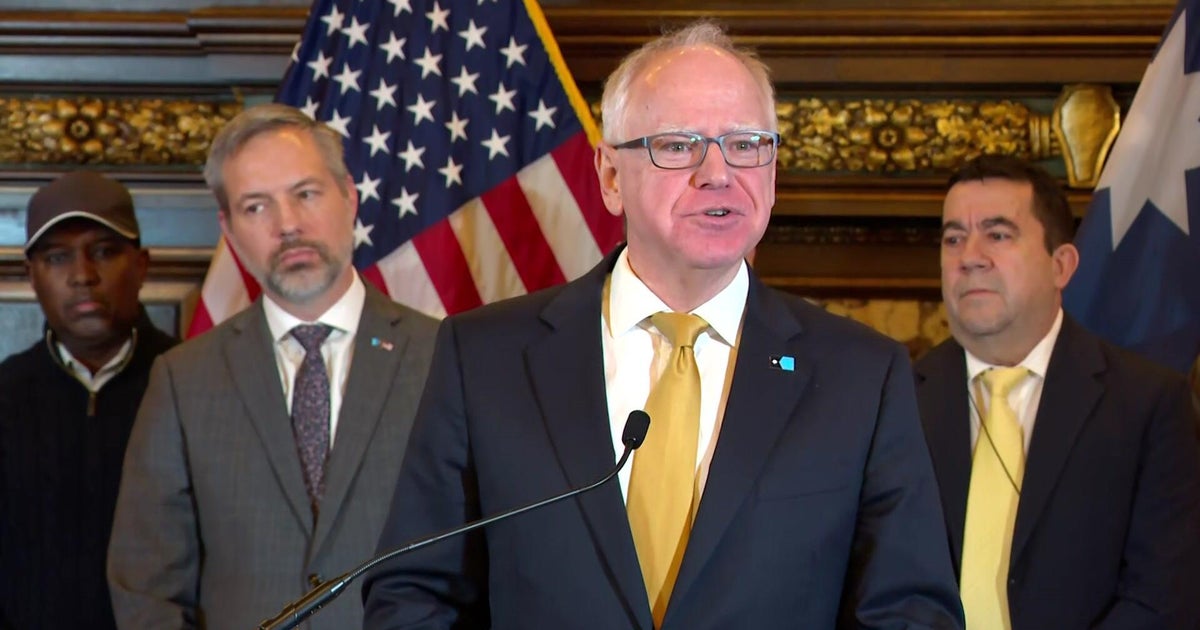
Minnesota Gov. Tim Walz said he was “cautiously optimistic” about Border czar Tom Homan’s announcement Thursday morning that the immigration enforcement operation in the state is concluding.
Walz said Operation Metro Surge — which at its peak saw 3,000 federal agents across Minnesota and has led to over 4,000 arrests — was “an unprecedented federal invasion in all aspects of life” and “unlike anything we’ve witnessed.”
“And through that entire time, the dignity, the compassion, the love, the care and the absolute determination to do what is right never wavered amongst Minnesotans,” Walz said. “I think it’s probably safe to say the rest of the country will be forever grateful because we showed what it means to stand up for what’s right.”
Walz said that the proposed drawdown still leaves many questions, including the status of the investigations into the fatal federal law enforcement shootings of Alex Pretti and Renee Good.
Talks between federal and local officials started to coalesce when Homan arrived in Minneapolis, Walz said. The Trump administration had sidelined Border Patrol Commander Greg Bovino, who Walz said he had never spoken to, but he was able to get a conversation moving with Homan soon after he arrived.
Walz said he expects to be back to the “pre-surge number” of federal agents, and there’s “no reason not to believe” Homan’s word.
What’s next, he added, is focusing on recovery, especially for small business owners.
Walz announces funds for small business recovery
Walz said his administration will reinstitute the small business emergency fund, which was implemented during the COVID-19 shutdown. He also announced $10 million in forgivable loans, acknowledging that the funds are a “very small piece” of the puzzle of economic recovery. Eligible businesses would be able to apply for forgivable loans ranging from $2,500 to $25,000, according to Walz.
Last week, several Twin Cities small businesses said Operation Metro Surge has cost them millions of dollars in revenue. Minneapolis’ Lake Street corridor alone is down $46 million in revenue between December 2025 and January 2026, according to city officials. Business leaders have said that even after federal immigration officers leave, the recovery would take months.
“Recovery will not happen overnight. Families, workers, and business owners are feeling the effects and our responsibility is clear: we will help rebuild, stabilize these businesses, protect jobs, and ensure Minnesota’s economy can recover and thrive,” Walz said.
Workers and customers have said they don’t feel comfortable showing up to small businesses for fear of being detained.
Henry Garnica, the owner of the grocery store Centromex in St. Paul, said “everything has changed” since the start of Operation Metro Surge. His own store was a target, and though none of his employees were detained, Garnica said that sales are down between 30% and 40%.
“These businesses are part of the fabric of our neighborhood and our vibrant economy in Minnesota,” said Garnica, who said he came from Columbia 23 years ago “looking for the American dream.”
While officials say they’re still assessing the damage done to the state economy, the same energy of resistance that Minnesotans have shown over the past few weeks must be directed towards recovery, Walz said. With an eye on the legislative session that starts next week, he said one of the goals is to protect Minnesota businesses.
Small businesses say more help is needed
Soleil Ramirez, head chef and owner of the Venezuelan restaurant Crasqui in St. Paul, told WCCO earlier this week that Walz wasn’t doing enough to help those in his own state. Ramirez said that the loan package proposal is a welcome idea, but said she needs to learn more; she’s also concerned about how much faith she can put in Homan’s words spelling out the end of Operation Metro Surge.
“It’s going to take weeks for us to really believe,” Ramirez said, “The fear in people, it’s completely embedded. This is something that’s not going to change.”
That kind of widespread fear – as ICE agents detained American citizens and those seeking asylum throughout the surge – is the root of the economic problem, according to Ramirez. She said that she and similar businesses need $14,000 to $25,000 per week to operate, and through January, she said her restaurant experienced a major drop in revenue. It’s the first time, she said, that she’s ever been behind on rent and other payments.
It’s why Ramirez is lobbying for other forms of relief, including temporary suspension of payments on licensing fees or sales tax. Alma Flores, executive director of the Latino Economic Development Center (LEDC), said she’s continued to effort those kinds of solutions in talks with St. Paul city government leaders.
“We want to make sure that we are able to provide the needed resources for them to recover once ICE agents leave,” Flores said.
The LEDC conducted a survey of 92 businesses, finding that around 30 of them are temporarily closed due to Operation Metro Surge. More than 40 are operating with adjusted hours or staff sizes. Four are closed permanently.
When it comes to recovery needs, Flores said that they are overwhelmed. After announcing that her organization would make funds available for grants, the LEDC got about 364 applicants with needs that collectively totaled $4.48 million. That’s why she said that Walz’s loan proposal will likely only serve as a first step, believing the total figure needed in the private sector will dwarf $10 million.
Yusra Mohamud, business advisor with the Lake Street Council, said that businesses along that critical corridor in south Minneapolis are in similar positions. That organization estimates losses of about $46 million through the month of January.
“[ICE] enforcement activity was disrupting commerce daily. Impossible choices were made by business owners,” Mohamud said.