


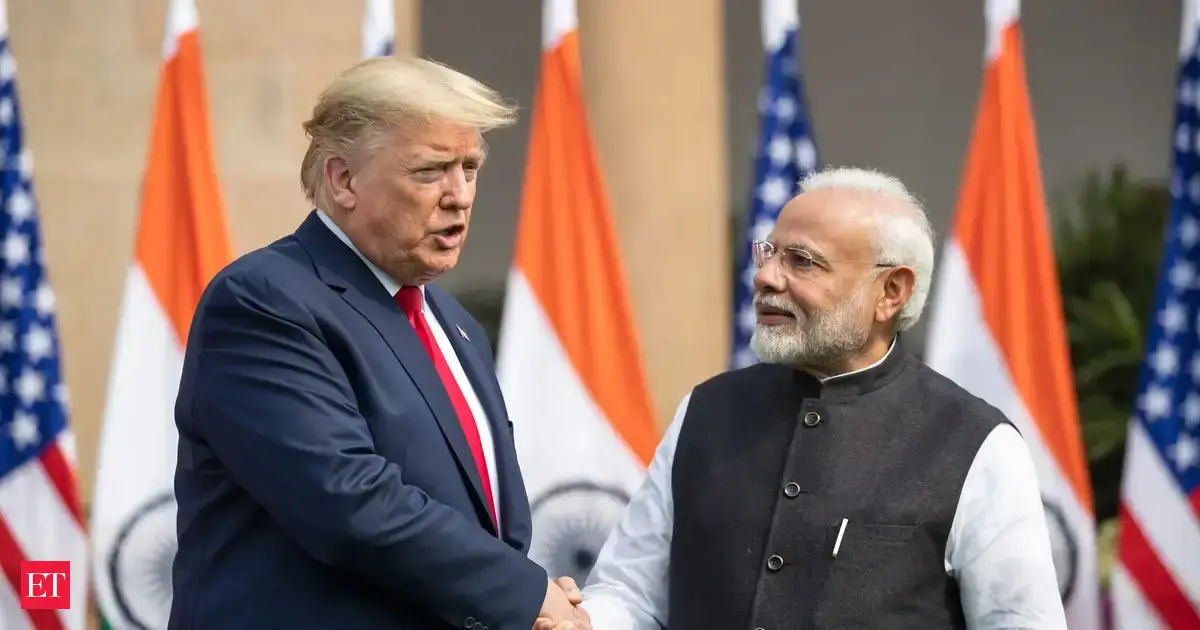
In a fact sheet released late Monday, the White House said the arrangement is designed to expand trade while aligning economic and national security priorities.
The document follows a Joint Statement issued last Friday after a call between US President Donald Trump and Prime Minister Narendra Modi, where the leaders agreed on a framework for an interim reciprocal trade agreement and reaffirmed their commitment to broader negotiations toward a full Bilateral Trade Agreement.
The White House said the understanding would open India’s vast consumer base to American exporters while deepening bilateral supply chain and technology cooperation.
India-US trade deal: Fine print separates fear from facts
No more re-routing of foreign goods?
Central to the framework is a shift in tariff policy. Trump has agreed to remove an additional 25 percent tariff on Indian imports after India committed to halt purchases of Russian oil. The United States will also reduce the reciprocal tariff on India from 25 percent to 18 percent, citing India’s willingness to align with Washington on trade imbalances and shared security concerns.
The fact sheet stressed that the two countries will negotiate rules of origin “that ensure that the agreed benefits accrue predominately to the United States and India,” signalling an effort to prevent third countries from indirectly capturing concessions granted under the deal.
India-US trade dealFrom India’s perspective, the framework reflects both opportunity and obligation. The White House said India will “eliminate or reduce tariffs on all U.S. industrial goods and a wide range of U.S. food and agricultural products,” including items such as dried distillers’ grains, red sorghum, tree nuts, fruit, certain pulses, soybean oil, wine and spirits.
India-US trade deal: Farmers may get cover as tariffs on certain American agri-related products to ease over 10 years
New Delhi has also committed to scale up purchases of American goods across sectors. According to the fact sheet, India will “purchase over $500 billion of U.S. energy, information and communication technology, agricultural, coal, and other products,” alongside steps to address non tariff barriers affecting bilateral commerce.
Digital trade is another pillar of the proposed arrangement. The Trump administration claimed that India will remove its digital services taxes and negotiate bilateral rules that prohibit customs duties on electronic transmissions while addressing “discriminatory or burdensome practices and other barriers to digital trade.” The two sides also pledged stronger economic security coordination to improve supply chain resilience, cooperate on investment screening and export controls, and expand joint technology collaboration.
$500 billion annual trade: What India, the US have agreed upon
The White House framed the initiative within a broader critique of existing trade dynamics. It said India maintains some of the highest tariffs faced by American exporters among major economies, with agricultural tariffs averaging 37 percent and duties on certain automobiles exceeding 100 percent. It also cited India’s use of non tariff barriers that have restricted US exports.
At the same time, Washington presented the evolving framework as part of a wider push for balanced trade. The fact sheet noted that President Trump had declared a national emergency on April 2, 2025, in response to the persistent US goods trade deficit driven by “a lack of reciprocity in our bilateral trade relationships” and unfair barriers imposed by trading partners.
Looking ahead, both countries plan to implement the framework in the coming weeks and work toward finalising the interim agreement, with the longer term objective of concluding a comprehensive Bilateral Trade Agreement. Negotiations will continue across tariffs, services, investment, intellectual property, labour, environment, government procurement and other regulatory areas.
India-US trade deal: America has stopped short of Indian red lines
For India, the proposed deal signals deeper integration with the US economy alongside policy adjustments in tariffs, digital taxation and procurement. For Washington, it represents what the White House described as “a tangible path forward with India” toward balanced and reciprocal trade with a key strategic partner.