


Iran Vows Response After Ukraine’s Caspian Sea Strike
A single strike far from the front lines of the Ukraine war has opened a dangerous new fault line — and dragged Iran squarely into a conflict it insists it has nothing to do with.
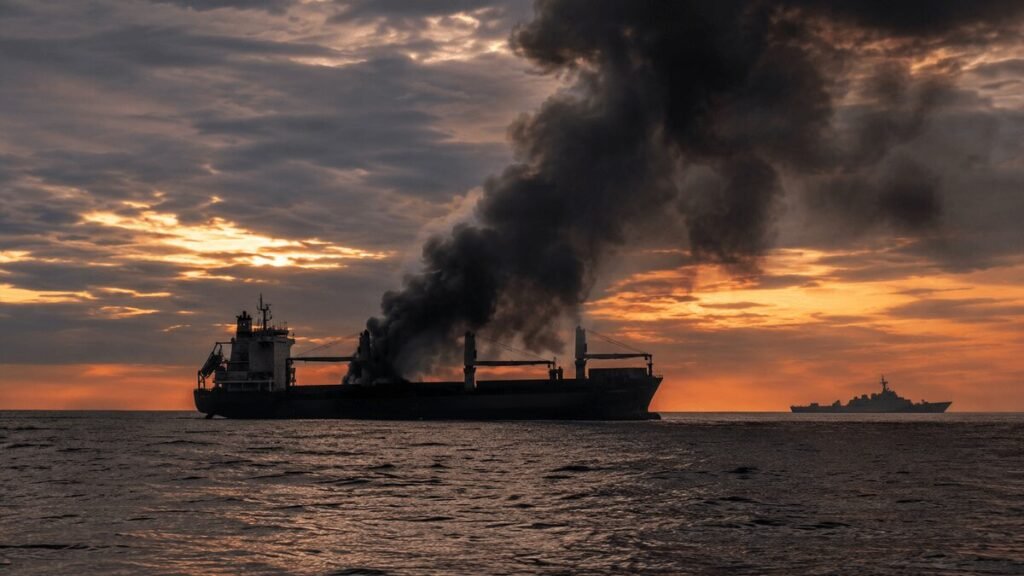
Tehran reacted with fury to a Ukrainian assault on a vessel in the Caspian Sea, an attack it says killed one sailor and injured several others. What might once have been a distant naval incident has instead become a flashpoint linking the wars in Ukraine and the Middle East, complete with angry diplomacy, threats of retaliation, and a bitter exchange over who is telling the truth.
Here’s what happened, why it matters, and where it could lead.
What Iran says happened
Iran’s account of the strike is unambiguous and furious.
The country’s foreign ministry said the attack killed one sailor and wounded others aboard what it describes as a purely commercial vessel. Crucially, Tehran insisted it has no role in the war being fought hundreds of miles away, stating flatly that Iran had “never intervened in the conflict between Russia and Ukraine.”
Iranian Foreign Minister Abbas Araghchi went further, framing the strike as a deliberate provocation. He called it “a blatant UN Charter violation done at Israel’s behest to drag Europe into its war.” In a post on X, he declared that the incident “CANNOT GO UNANSWERED.” theprint
Iran’s foreign ministry summoned Ukraine’s chargé d’affaires in Tehran to protest what it called a “hostile and criminal” attack, and described the incident as a violation of Article 2(4) of the United Nations Charter. Araghchi also raised the matter directly with the EU’s foreign policy chief Kaja Kallas, reportedly calling for a firm response from the UN Security Council and the wider international community. Washington ExaminerWashington Examiner
Ukraine’s very different version
Kyiv tells a starkly different story — and rejects the “commercial vessel” framing outright.
Ukrainian President Volodymyr Zelensky confirmed the operation, casting it as a legitimate military strike. He said Ukraine had achieved “very strong results with long-range strikes in the Caspian Sea – including vessels used in military cargo shipments involving Iran, as well as a warship.” theprint
Ukrainian officials have been more specific about the cargo. Ukraine’s ambassador to Israel said the ship struck in the Caspian Sea contained components for drones and missiles bound for Iran. From Kyiv’s perspective, that makes the vessel fair game, not an innocent trader. Al Jazeera
Ukrainian Foreign Minister Andrii Sybiha escalated the war of words on Monday. He reposted Araghchi’s statement, stamping the words “Iranian lies” across it. Sybiha also accused Iran of trying to distract from Russia’s own attacks on ships carrying grain out of Ukrainian ports — strikes he said threaten global food security.
Why the Caspian Sea suddenly matters
To understand the strike, it helps to understand the map.
The Caspian Sea has become a vital artery between Russia and Iran, two countries pushed into an ever-closer partnership since Moscow’s 2022 invasion of Ukraine left it diplomatically isolated. The sea offers Russia and Iran an easy trade route, including a corridor for shipping military components, and it was long considered safe from Ukrainian attack. theprint
That safety no longer holds. Kyiv has vastly expanded its drone range over the past year or two, bringing targets that were once untouchable within reach. theprint
Days before the deadly incident, Ukraine had already signaled its intent in the region. Kyiv’s military said it struck the Caspian port of Olya in Russia’s Astrakhan region, hitting a ship it said had been transporting drone parts and ammunition from Iran. The latest strike fits squarely into that pattern.
Part of a bigger economic squeeze
The Caspian operation is not an isolated act. It’s the newest front in a wider campaign Zelensky has branded Ukraine’s “long-range sanctions campaign.”
For months, Ukraine has relentlessly targeted Russia’s so-called shadow fleet of oil tankers, the aging vessels Moscow uses to skirt sanctions and keep oil revenue flowing. Choking off that money is central to Kyiv’s strategy of striking at the Kremlin’s finances rather than only its soldiers.
That effort has broadened well beyond tankers. Drone strikes have hit Russian oil depots and even the warehouses of the Wildberries online retail giant. Taken together, these long-range operations are landing an increasingly serious blow to the Russian economy — hitting fuel production, logistics, and export income all at once.
Seen through that lens, the Caspian strike isn’t a sudden pivot toward Iran. It’s an extension of a campaign aimed at strangling the supply networks that keep Russia’s war machine running.
Is Ukraine picking a fight it doesn’t need?
Not everyone in Kyiv’s corner is convinced the strike was wise.
Some analysts warn that provoking Iran carries real risks for a country already stretched by a grinding war with a far larger adversary. Former intelligence official Ivan Stupak captured the concern bluntly. The main aim, he told the BBC, is to disrupt trading routes and cause as much damage as possible — but he cautioned that opening another battlefront with Iran “is not a good idea for Ukraine” and “not good for us.” The Express Tribune
Others read the operation more coolly. Olha Polishchuk of the Armed Conflict Location and Event Data Project (Acled) argued the Caspian strike was less about starting a war with Tehran and more about squeezing Russia. She described it as an extension of Kyiv’s targeting of the networks propping up the Russian war effort, saying that hitting that route lets Kyiv pile further pressure on Moscow’s supply chains beyond the traditional battlefield.
The tangle of alliances
What makes the episode so combustible is the web of alliances underneath it.
Ukraine and Iran are not at war with each other. But each is closely aligned with the other’s chief adversary — Ukraine with the West and, by extension, Israel; Iran with Russia. That leaves the two countries as rivals by proxy, and Araghchi’s claim that the strike was carried out “at Israel’s behest” reflects exactly that underlying tension of mixed alliances. theprint
The response from Moscow underscored the point. Russian Foreign Minister Sergey Lavrov offered condolences over the sailor’s death and stressed the need to “put an end to such adventures by the Kyiv regime.” The Express Tribune
What comes next
For now, the most pressing question is whether Iran’s warning that the strike “cannot go unanswered” translates into action — and if so, what form it takes.
A senior Iranian lawmaker has already warned Ukraine could face retaliation, saying any attack on Iran “always comes with a cost.” Yet Tehran is also juggling other pressures, and a direct confrontation with Ukraine would stretch it in uncomfortable new directions. The Express Tribune
The deeper significance may lie in what the strike reveals about modern conflict. What began as Russia’s invasion of Ukraine has steadily bled into the rivalries of the Middle East, until a drone over the Caspian Sea can ripple through capitals from Tehran to Brussels to Moscow. Increasingly, these wars are not separate stories — they are chapters of the same one.