


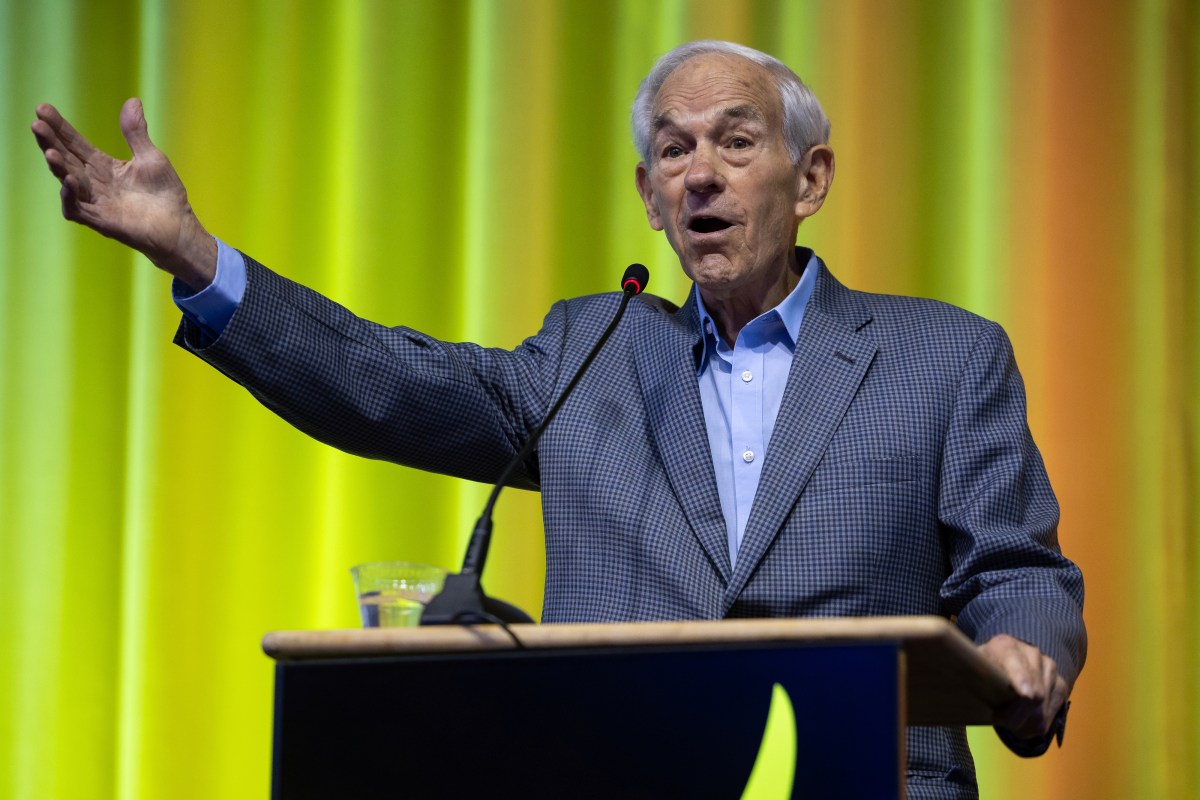
Former Texas Representative Ron Paul said the U.S. economic order rests on “fraud” rooted in the 1971 break from gold and warned that the current system is nearing its end, in a wide-ranging 90th-birthday interview on The Tucker Carlson Podcast released Thursday.
Paul, a Republican-turned-Libertarian-turned-Republican, tied his warning to the end of dollar convertibility into gold under President Richard Nixon, calling it the nation’s “first declaration of bankruptcy,” and argued that persistent money printing and deficits have created a brittle order primed for a severe correction.
Why It Matters
Paul’s critique echoed decades of libertarian skepticism about fiat currency and the Federal Reserve, and it came as host Tucker Carlson revisited a 2002 floor speech in which Paul predicted massive credit expansion, rising gold, and expanding state power—trends Carlson described as “so precise that it’s spooky.”
Paul’s standing as a longtime Republican lawmaker and three-time presidential candidate has made his monetary warnings influential among voters skeptical of federal spending and overseas entanglements, giving his latest alarm outsized resonance with audiences concerned about inflation and debt sustainability.
What To Know
Paul argued the U.S. monetary system became “fraud” when the dollar was detached from gold, saying, “you just can’t print money and lie to the people forever,” and calling the post-1971 currency regime “counterfeit money.”
He described the 1971 shift as “our first declaration of bankruptcy,” adding that policymakers convinced themselves they could avoid the “trouble that printing money and subsidizing big government always fails.”
Paul said the present order—“special interests running things”—is “coming to an end,” framing the transition as turbulent but ultimately clarifying for the country’s political and moral direction.
The episode featured archival clips of Paul’s 2002 House remarks predicting “massive credit expansion” by the Federal Reserve that would worsen a dollar crisis and leave Americans “poorer and less free” and more dependent on government for security, which Carlson presented as evidence of his prescience.
Paul situated his politics within a moral framework—“no lie, cheating, stealing, and killing”—and said those standards must bind government as well as individuals, reiterating his nonviolence-first approach to policy and foreign affairs.
Questioned by Carlson on whether post–World War II conflicts improved life for Americans, Paul answered, “Probably not,” underscoring his long-standing opposition to military adventurism and its economic costs.
The economic views Paul outlined in the interview are part of a long‑running critique of fiat currency (state-backed money not backed by a physical commodity, with its value ascribed to it by government decree and economic stability) that has also drawn sustained pushback from mainstream economists and policymakers.
What People Are Saying
Ben Bernanke, former chair of the Federal Reserve, said in a 2012 lecture: “The gold standard would not be feasible for both practical reasons and policy reasons. […] In a modern world, the commitment to the gold standard would mean that we are swearing that under no circumstances, no matter how bad unemployment gets, are we going to do anything about it using monetary policy.”
Economist Paul Krugman wrote in a 2013 New York Times column: “Ever since the financial crisis struck, and the Federal Reserve began ‘printing money,’ there were dire warnings about inflation. […] All those inflation fears were wrong, and those who fanned those fears proved that their economic doctrine is completely wrong.”
What Happens Next
Paul said the path forward is ideological, not violent, urging education in Austrian economics and the spread of liberty-focused ideas, adding that the internet has enabled more Americans to engage these debates despite institutional resistance.
By Austrian economics, Paul is referring to a school of thought that stresses sound money, limited government intervention, and skepticism toward central banking. Associated with economists such as Ludwig von Mises and Friedrich Hayek, it holds that excessive money creation and debt distort markets and eventually lead to economic instability.
He expressed optimism about the “end” of the current system as a clarifying moment—both a crisis and an opening—for those advocating sound money, nonintervention abroad, and a limited state grounded in moral rules that also bind government action.