


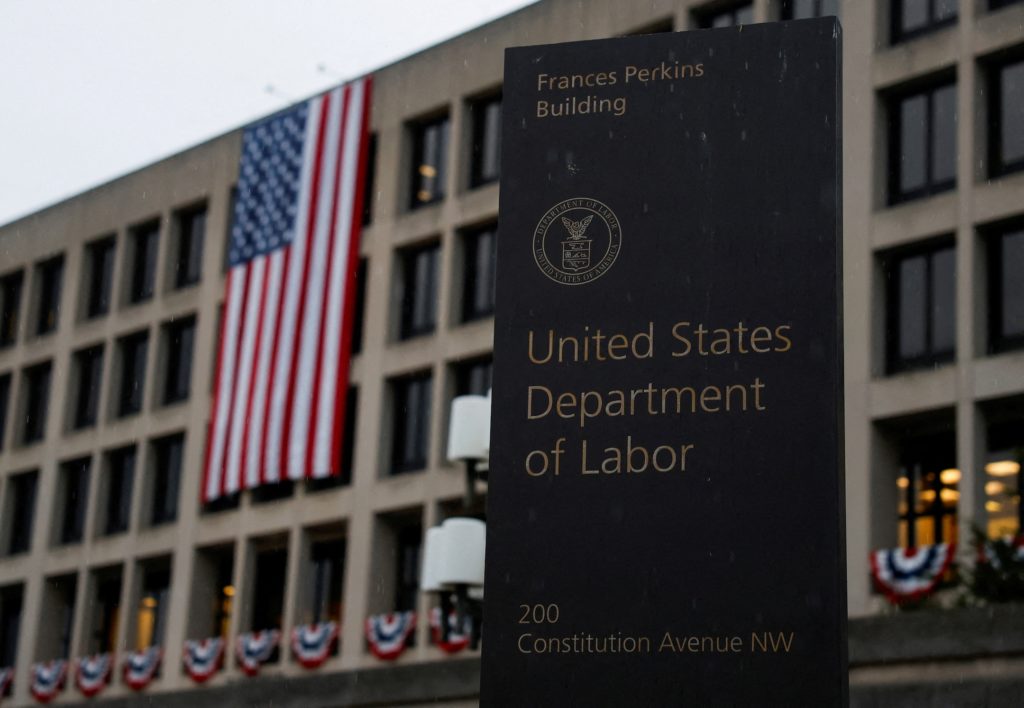
The U.S. economy opened 2026 on better footing, with the latest jobs report showing employers added 130,000 jobs in January. But the data also had revised figures that paint an even weaker picture of last year’s performance. It comes as some corporations like Amazon and UPS are announcing layoffs. Geoff Bennett discussed more with Harry Holzer, a former chief economist for the Department of Labor.
Amna Nawaz:
The U.S. economy opened 2026 on better footing, with the latest jobs report showing employers added 130,000 jobs in January. And the unemployment rate edged down to 4.3 percent from 4.4 percent in December, a stronger-than-expected result for last month.
Geoff Bennett:
But the data also had newly revised figures that paint an even weaker picture of last year’s performance. The U.S. economy added just 181,000 net jobs last year, about 400,000 fewer than initially reported, and far from the 1.4 million jobs added in 2024.
This all comes as some corporations like Amazon and UPS are announcing tens of thousands of layoffs.
To break down all these numbers. And what it all means for the U.S. economy, we’re joined now by Harry Holzer, a professor of public policy at Georgetown University. He’s a former chief economist for the Department of Labor.
Thanks for being here. We appreciate it.
Harry Holzer, Professor of Public Policy, Georgetown University: Thank you. Nice to be here.
Geoff Bennett:
So we should say 130,000 jobs added is not a strong number. Not long ago, that number would have been reported as underwhelming. Why have the goalposts shifted?
Harry Holzer:
Well, because job growth all of last year was so weak. So compared to a lot of the weakness we saw in 2025, 130,000 is a pretty good number.
So relative to that. But another misleading thing about that, and this has been true for a while, almost all of the job creation is limited to a few key sectors, like health care, social assistance, and, this month, construction and professional services. There were other sectors that actually had job loss.
Geoff Bennett:
And what are those? What sectors remain under pressure?
Harry Holzer:
Last month, we saw declines in information technology, in financial services, and continuing declines in the federal government, federal government because of DOGE activities and other cutbacks. Federal government shed about 300,000 workers last year.
They dropped another 33,000 to 34,000 last month.
Geoff Bennett:
And the revisions to last year’s numbers are also striking. Just 181,000 jobs were added in 2025. That’s about 14 percent of the gains that we saw in 2024. What does that say about the underlying strength of the economy?
Harry Holzer:
Well, the economy weakened in 2025. There was so much uncertainty. The policy environment was so chaotic, tariffs and immigration cuts and things like that. I think employers face less consumer demand in the market, and they just had so much uncertainty about what was going to happen month to month that they cut way back.
Of course, the other factor was less immigrant — fewer immigrants coming into the market, and therefore fewer workers available for being hired.
Geoff Bennett:
And there’s been a surge in corporate layoffs, as we mentioned. The global outplacement firm Challenger, Gray & Christmas released a report that said layoffs were 118 percent higher compared with January of 2025.
What kind of warning sign does that send? Or is this a normalization after pandemic era overexpansion?
Harry Holzer:
I think, for the tech sector, for companies like Amazon, some of it is normalization and that’s been going on for a few years already. But some of it is they have invested very heavily in A.I. with the idea that they’re going to — that’s going to save them on labor costs and they want to start seeing the returns on that investment.
So they’re announcing some cutbacks. More broadly, we’re not seeing an enormous number of layoffs, but they are a bit higher, certainly relative to a year ago and even relative to last month. You see some uptick in layoffs. Most of the decline has been new hiring, rather than layoffs, but it’s something to keep an eye on.
Geoff Bennett:
Yes. You could argue we’re not in a recession, but for a lot of workers and Americans generally, it might feel like one.
Claudia Sahm, the former Fed economist, she noted that the 181,000 jobs you mentioned earlier in an economy of 158 million is basically nothing. And then you have the Fed Governor Chris Waller — he’s a Trump appointee — he mentioned in his dissent that the recent payroll gains do not remotely look like a healthy labor market.
Is this a cyclical cooling or is something more structural happening beneath the surface here?
Harry Holzer:
We’re not sure yet. And that’s why from one month to the next, we keep watching the numbers closely.
I think both of those comments are basically accurate, just very, very little new hiring going on, for the reasons that I have already said, because businesses face so much uncertainty. There was a drop-off in consumer demand.
Normally, when new hiring drops that much, you see the unemployment rate go up by more than this small uptick to 4.3 percent. There again, the drop-off in immigration means the labor force is shrinking as well. Fewer new workers are entering the labor market to find jobs. So the good news there is that unemployment doesn’t go up that much.
The bad news is that it causes other problems for the labor market, less GDP growth, perhaps more inflation, things like that. Over the long term, our pool of scientific talent will drop if immigrants are scared to come here. So there’s a pretty big downside for that as well.
Geoff Bennett:
Harry Holzer, thanks so much for sharing your insights.
Harry Holzer:
Thank you.