


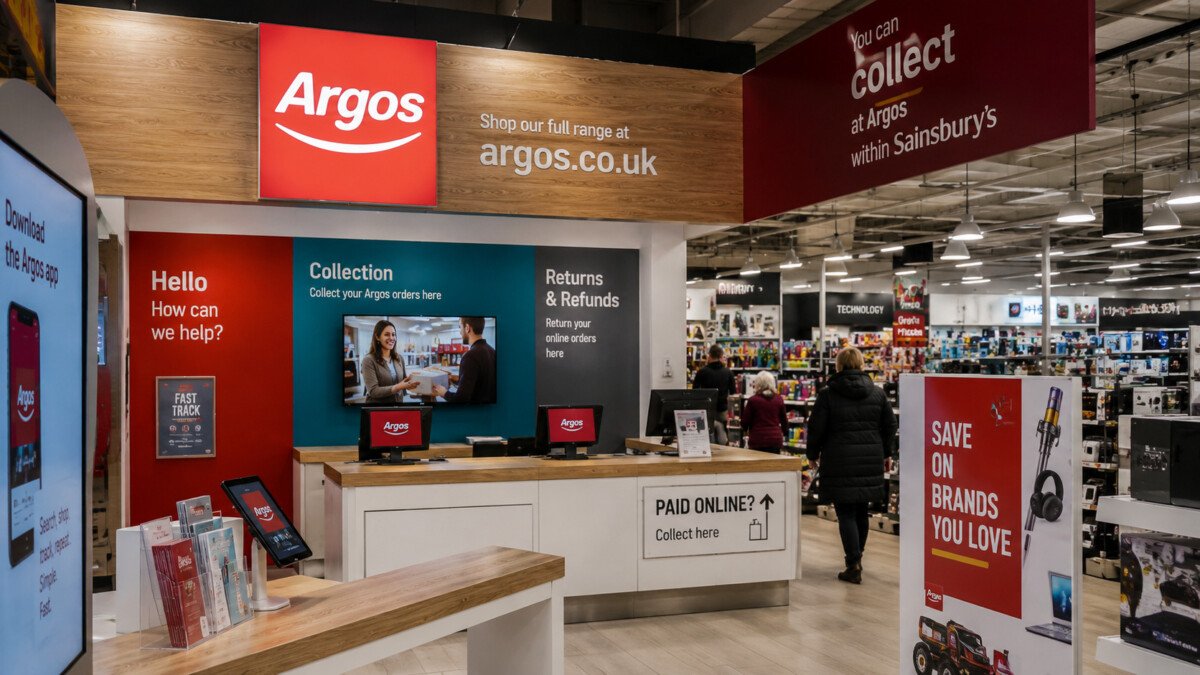
After nearly a decade of ownership, Sainsbury’s is letting go of Argos. And the price tag tells a striking story about how much has changed.
Britain’s second-biggest supermarket has agreed to sell Argos to Swift Partners, a newly formed retail vehicle, in a deal expected to deliver at least £120 million in cash proceeds. That’s a headline-grabbing figure for one reason above all: Sainsbury’s paid around £1.4 billion to bring Argos into the fold back in 2016, as part of its takeover of Home Retail Group.
Here’s a clear breakdown of the deal, who’s buying, and what it actually means if you’re an Argos shopper.
The Deal at a Glance
Let’s start with the essentials of the Sainsbury Argos sale.
Sainsbury’s is selling Argos Limited to Swift Partners — formally Swift Whistle Midco Limited — with completion expected in February 2027. The supermarket anticipates cash proceeds of at least £120 million in total. Of that, at least £70 million is expected on completion, with a further £50 million in deferred payments spread over the following three years. The overall sum also includes proceeds from the sale of an Argos distribution centre.
There’s fine print worth noting: the final figure is subject to working capital adjustments and is expected to be offset by separation costs over the next few years. Sainsbury’s also flagged that its lease-adjusted net debt should fall by around £250 million, reflecting reduced lease liabilities. Crucially, the supermarket will retain responsibility for Argos’ defined-benefit pension scheme.
What Swift Partners Is Actually Buying
This isn’t a piecemeal sale — Swift is taking on the whole Argos operation.
The assets changing hands include Argos’ standalone stores, its store-in-store concessions inside Sainsbury’s supermarkets, its online retail channels, its logistics network, and its sourcing offices in Shanghai and Hong Kong. The package also sweeps in Argos Care, Argos Pet Insurance, and a distribution site in Daventry. Swift will assume the leases across the Argos property estate, while Sainsbury’s holds onto certain limited residual lease liabilities and parental guarantees that it expects to reduce over time.
In short, Swift is buying a fully operational, multichannel retailer — brand, stores, website, warehouses, and all.
Who Are Swift Partners?
A £120 million retail acquisition is only as credible as the people behind it, and this is where the deal gets interesting.
Swift Partners was established specifically for this acquisition by a trio of heavyweight names — Richard Pennycook, Trevor Strain, and Matt Truman — alongside specialist investor True Capital. Pennycook is best known as the former chief executive of the Co-operative Group, where he earned a reputation for steering the business through a turbulent turnaround. The group combines deep retail ownership and leadership experience with expertise in technology, digital innovation, and AI transformation.
Pennycook made clear what drew the group in, pointing to the strength of the Argos business — a trusted brand, loyal customers, and dedicated colleagues — and saying the team sees real opportunities to invest and build on its progress. It’s a vote of confidence in a business that has struggled to find its footing under supermarket ownership.
Why Is Sainsbury’s Selling?
The strategic logic here is refreshingly blunt: Sainsbury’s wants to be a food business, full stop.
Chief Executive Simon Roberts framed the sale as a further step forward in the group’s strategy, noting that having rebuilt the core strengths of its food business, the deal now lets the company focus all its resources and investment on the opportunities ahead. He also credited the supermarket with transforming Argos into a leading multichannel retailer with millions of customers and thousands of colleagues — while carefully weighing what it would take to build the strongest possible future for the brand.
Reading between the lines, the message is clear. General merchandise is a fast-moving, fiercely competitive market, and Sainsbury’s has decided that competing there is a distraction from groceries. Offloading Argos creates what the company describes as a simpler business with higher margins, higher growth, and stronger free cash flow generation — the backbone of its “Next Level Strategy.”
Will Shoppers Notice Any Difference?
If you regularly use Argos, here’s the reassuring part: not for a while.
Until the deal completes in February 2027, Argos and Sainsbury’s will continue to operate exactly as they do today, with no change for customers as a result of the announcement. And the two companies have deliberately built continuity into the arrangement for the longer term.
Alongside the sale, Sainsbury’s and Swift have entered a series of long-term commercial agreements. These cover Argos stores and collection points within Sainsbury’s branches, Sainsbury’s continuing to sell Habitat products, and Argos’ ongoing use of Sainsbury’s key services — including its Collection Points, the Nectar loyalty programme, and Nectar360’s insight and retail media network services. So the Argos-inside-Sainsbury’s model that shoppers know isn’t vanishing overnight. Full separation is expected by February 2029.
What It Means for Sainsbury’s Bottom Line
For investors, the financial takeaway is measured rather than dramatic.
Sainsbury’s expects the deal to have a broadly neutral impact on underlying operating profits. The lost contribution from Argos is set to be offset by commercial income from those long-term agreements and lower lease interest costs, resulting in low single-digit earnings-per-share accretion and improved retail free cash flow. The company continues to forecast total underlying operating profit between £975 million and £1,075 million and retail free cash flow above £500 million in FY27.
In plain terms: Sainsbury’s isn’t selling Argos for a quick cash windfall. It’s selling for focus — trading a sprawling, hard-to-manage general-merchandise arm for a leaner, more profitable grocery-first business.
The Big Question: Can Swift Succeed Where Sainsbury’s Couldn’t?
That £1.4 billion-to-£120 million journey looms over everything, and it raises the obvious question.
The gap between what Sainsbury’s paid and what it’s now accepting speaks volumes about how challenging general merchandise has become — squeezed by online-only rivals, shifting consumer habits, and thin margins. Sainsbury’s spent nearly a decade trying to make Argos thrive under its roof and ultimately concluded its energy is better spent elsewhere.
Swift is betting it can do things differently. With dedicated ownership, fresh investment, and a leadership team steeped in retail turnarounds and digital transformation, the new owners believe a focused, standalone Argos can accelerate growth in ways a supermarket parent couldn’t prioritise. Whether that optimism proves justified is the story to watch over the next few years.
The Bottom Line
The Sainsbury Argos sale to Swift Partners marks the end of an era and the start of an experiment. For Sainsbury’s, it’s a decisive pivot back to food and a cleaner balance sheet. For Argos, it’s a chance at a fresh, focused future under owners who say they genuinely believe in the brand.
For shoppers, the practical answer is simple for now: nothing changes ahead of completion in early 2027, and the familiar Argos-in-Sainsbury’s setup is contractually protected well beyond that. The real test comes afterwards — when Swift finally gets the keys and has to prove it can revive one of Britain’s most recognisable retail names where a supermarket giant decided it couldn’t.