



It’s a good thing that Nvidia’s Q4 2025 earnings beat expectations yesterday, because an increasing portion of U.S. GDP growth is coming from AI capital expenditures (capex) and the “wealth effect” from tech stock gains on consumer spending, according to a new analysis from Pantheon Macroeconomics.
AI capex “accounted for nearly a fifth of the 2.2% year-over-year increase in headline GDP in Q4,” Pantheon’s Samuel Tombs and Oliver Allen said in a note to clients this morning.
In addition, the value of households’ holdings of Magnificent Seven tech stocks increased by $3.8 trillion in 2025, they estimate. Using historic trends as a guide, that increase in wealth drove an increase in consumption by 0.4 percentage points in Q4 2025, adding 0.3 points to GDP growth, they said. (The “wealth effect” is the phenomenon that describes how consumers tend to increase their spending when they feel richer due to a rise in the value of their houses or investments.)
All told, “AI-linked capex and the wealth effect from gains in tech stocks probably accounted for a third of headline GDP growth towards the end of last year,” they said.
“When combined with the direct boost to growth from AI capex, that would leave the economy vulnerable if investors started to doubt the AI story, prompting a big pullback in both stock prices and investment spending.”
The good news is that despite a recent wobble triggered by that infamous Citrini Research report predicting mass unemployment in 2028 caused by AI, recent data shows that the AI economy is holding up nicely.
Nvidia was up 1.44% yesterday and held up at 0.15% in overnight trading after spiking sharply 4% after CEO Jensen Huang’s earnings call last night. The company reported record-high revenue of $68.1 billion, up 73%, for Q4 2025, $3 billion more than its previous guidance.
Tech-heavy Nasdaq 100 futures were flat this morning. S&P 500 futures were flat also, after the index closed up 0.81% yesterday.
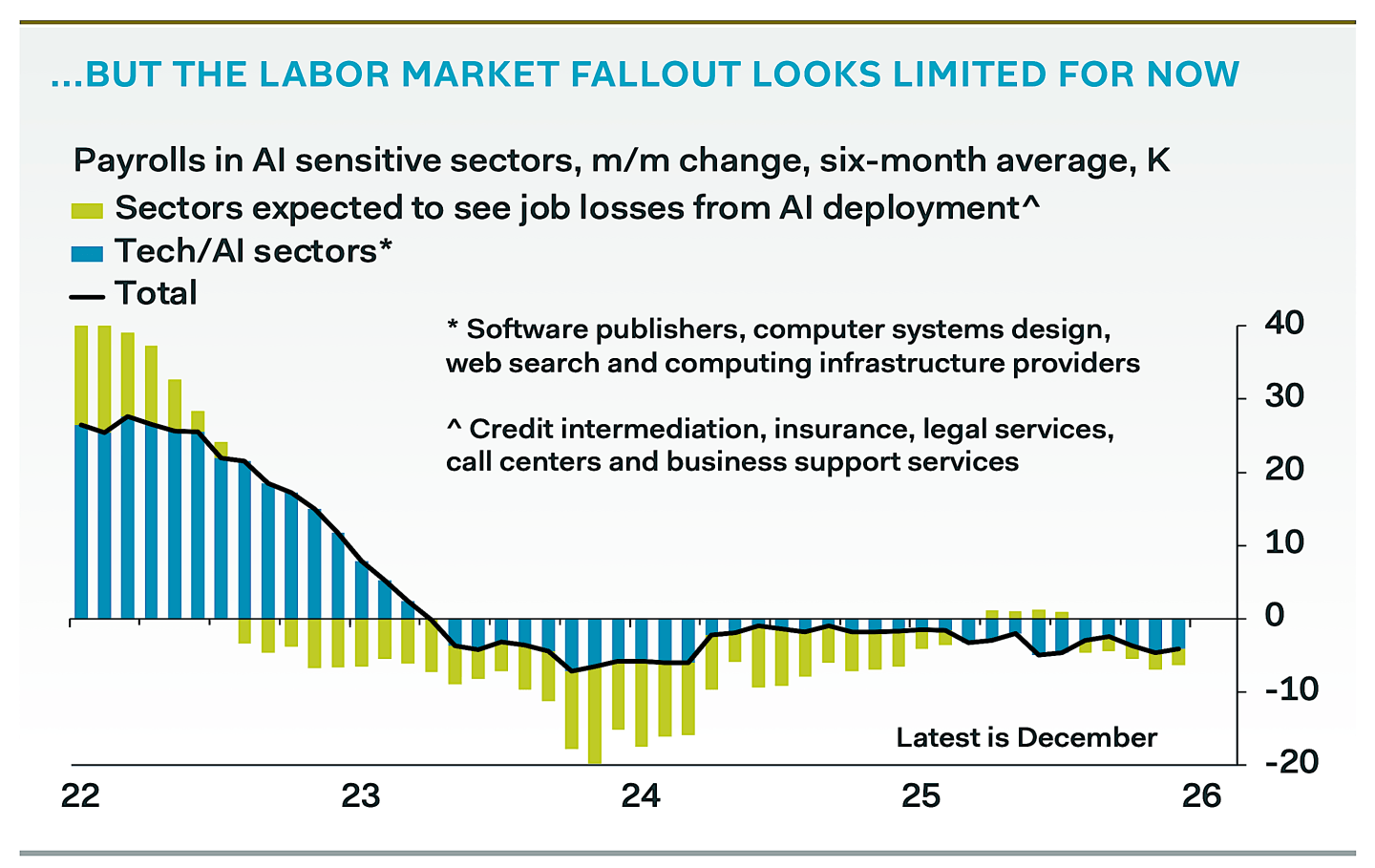
Pantheon believes that while AI has not yet shown up in headline productivity growth, there has been “an acceleration in productivity in those sectors where AI adoption currently is highest [like tech companies], offsetting a slowdown elsewhere. Productivity growth in the first group is meaningfully above its pre-pandemic trend,” the analysts said.
In addition, contrary to Citrini’s self-confessed “AI doomer fan-fiction” scenario, “For now, AI seems to be making workers in some roles more productive, but it is not yet advanced enough to replace them. We see little evidence to indicate that a big wave of AI-driven layoffs is on the immediate horizon.”

Here’s a snapshot of the markets this morning prior to the opening bell in New York:
- S&P 500 futures were flat this morning. The index closed up 0.81% in its last session.
- STOXX Europe 600 were flat in early trading.
- The U.K.’s FTSE 100 was up 0.13% in early trading.
- Japan’s Nikkei 225 was up 0.29%.
- China’s CSI 300 is down 0.19%.
- The South Korea KOSPI was up 3.67%.
- India’s NIFTY 50 was up 0.23%.
- Bitcoin rose to $68K.