


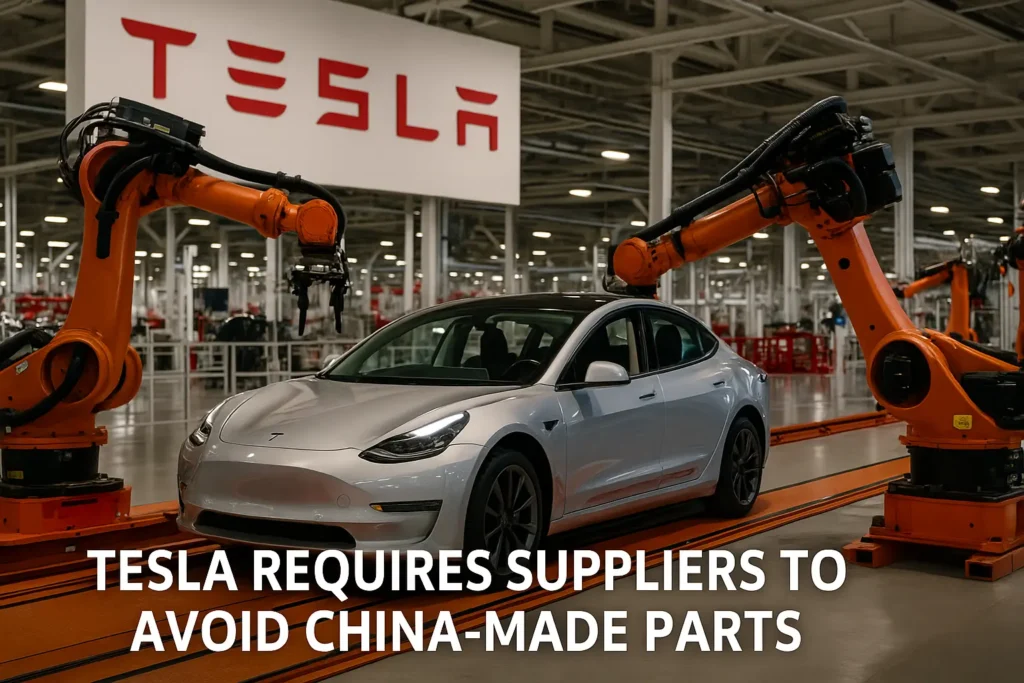
Tesla requires suppliers to avoid China-made parts, when building vehicles for the United States. On the surface, it might sound like a regular supply update, but people in the auto industry are treating it as a serious sign, that a bigger shift is underway. What seems, like a quiet sourcing decision is actually a signal, that companies are rethinking everything—from risk, and politics to production delays, and long-term stability.
China has spent decades becoming the center of global auto manufacturing. Many companies depended on its factories because production there was fast, predictable and large-scale. Tesla used that system just like everyone else. But things look different now. The company appears to be reducing its dependence on China and building a supply network that can hold steady even when the world goes through unexpected shocks.
A Quiet Order With Big Consequences
People familiar with what’s happening say Tesla has instructed several suppliers to stop using China-made parts for U.S. vehicles. A portion of those components already meets the new rule, but others will need fresh designs or brand-new sourcing locations. Tesla wants this entire shift completed in roughly a year or two, which is a fast push by auto-industry standards.
Suppliers are not getting much freedom in this discussion. Tesla expects them to adjust, and if they cannot, they risk losing their contracts. Some suppliers can manage the change with a few tweaks. Others may have to shift whole production lines, switch materials or move work to factories in countries that fit U.S. trade expectations.
Why Tesla Is Making This Move
Tesla’s decision is not the result of one single issue. A handful of pressures have built up over time, and together they created the moment for change.
- Tariffs and Trade Pressure
U.S. tariffs on goods coming out of China have made costs difficult to predict. Parts that were affordable last year could suddenly spike in price because of a policy shift. Tesla wants more control over what it pays.
- Supply-Chain Vulnerability
Recent years exposed how fragile the world’s supply chains really are. A delay in one country can slow down an entire production line somewhere else. Tesla wants to reduce its exposure to these global disruptions.
- Political Expectations
There is growing pressure for the U.S. auto industry to rely less on China. Companies are being encouraged to bring production closer to home, or at least move it to countries that align with long-term U.S. interests. Tesla’s direction fits this trend.
- Competition and Future Planning
Other manufacturers have already started rethinking their sourcing strategies. If Tesla stayed heavily tied to China while rivals spread their risks, it could fall behind. The company wants to stay ahead of future problems rather than react to them later.
What This Means for Suppliers
Many suppliers now face a challenging period. Changing the origin of a single part is not as simple as shifting a delivery address. Some factories may need new certifications. Workers may need training to use new materials or machines. In some cases, companies may have to re-engineer parts entirely.
Some suppliers may move production to places like Mexico, India, Vietnam, South Korea or even back to the United States. Others may try staying near China but shifting just outside its borders. The choice will depend on cost, timing and how firmly Tesla enforces the rule.
How Tesla’s Costs Might Change
Tesla will likely face higher short-term manufacturing costs. China’s scale is hard to beat, so parts made elsewhere may cost more. But Tesla may gain something more important than price: stability. Paying a little extra for a part is sometimes better than dealing with surprise shortages that shut down production lines.
Tesla has also spent years improving its factory systems. The company might be able to balance out the higher costs with faster production and better efficiency elsewhere.
A Turning Point for the U.S. Auto Industry
This move affects more than Tesla alone. It’s a sign that the entire U.S. auto sector might be entering a new phase. For decades, automakers chased the cheapest manufacturing options. Now reliability, security and political alignment matter just as much.
Other auto manufacturers may follow Tesla’s lead, especially with pressure coming from government leaders, investors, and consumers, who want stronger supply chains. Tesla’s decision may push the industry to remake old products.
Challenges Tesla Will Face
This plan is ambitious, but not easy. Several issues could make the shift complicated:
Some parts are extremely difficult to source outside China, especially electronics and specialized battery materials.
Even if suppliers agree to the transition, setting up new factories or verifying new parts can take time.
Tesla still operates a huge business in China, so the company must avoid jeopardizing that relationship.
Any new supplier must match Tesla’s performance standards. One weak part can disrupt thousands of vehicles.
The Bigger Picture
Tesla requires suppliers to avoid China-made parts because it sees a world where global manufacturing is less connected than before. Political tension, security concerns and shifting trade rules are creating separate supply zones around the world. Tesla is acting early by reshaping its supply network before it gets forced into rushed decisions later.
The transition will take time. It will cost money. It might frustrate suppliers that have depended on China for decades. But Tesla is positioning itself for a future where supply-chain disruptions are no longer rare events—they’re normal.
What Comes Next
Over the next year or two, Tesla’s supplier map will start to look very different. Some long-time partners will stay. Some will shift production. Others may disappear from Tesla’s network entirely. The company’s U.S. operations will likely run on a supply chain built very differently from the one it used in the past.
People in the industry will watch closely to see whether Tesla can keep production moving smoothly during the transition. If the company succeeds, it will show that a large manufacturer can rebuild its supply chain without losing momentum.
Final Thoughts
Tesla’s decision to move away from China-made parts shows how the company now thinks about risk, global politics and long-term stability. This shift could influence the entire automotive industry and raise expectations for how resilient supply chains need to be in the years ahead.