


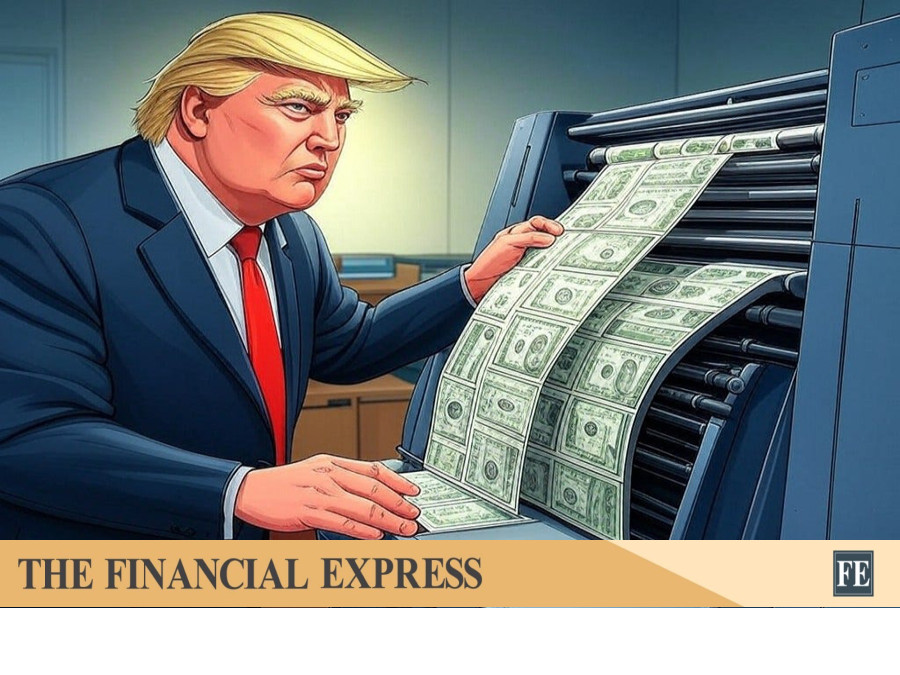
US President Donald Trump calls for a new world order, stating the United Nations (UN) must actively cooperate with the “Board of Peace.” His remarks at Davos-2026 emphasise global stability, diplomatic engagement, and peace-focused initiatives. Trump is now being described as possibly the US’s most “transformative” president — cheered by supporters at home and abroad, causing alarm among others in capitals around the world over.
US history is littered with consequential and controversial US invasions, occupations, and covert operations to topple rulers and regimes. But in the past century, no American president has threatened to seize the land of a long time ally and rule it against their will. No US leader has so brutally broken political norms and threatened long-standing alliances, which have underpinned the world order since the end of WW II. Sometimes he is called an isolationist, sometimes an interventionist. But there’s always that slogan which returned him to power -Make America Great Again.
When considered alongside the United States president’s interventions in Venezuela-including the abduction of the nation’s president and his spouse-as well as ongoing trade disputes, these actions indicate a shift toward a global economic model characterised more by direct state intervention and geopolitical rivalry than by adherence to traditional market principles. “He is a man of transactions and brute power, mafia style power,” says Zanny Minton Beddoes, editor-in-chief of the Economist magazine.
Mark Carney, the Canadian Prime Minister during his visit to China stated, “We have to take the world as it is, not the way we want it to be.” His candid remarks underscored the realities of a rapidly evolving global landscape. At Davos, Carney also said that Trump represented “a rupture, not a transition”.
To his credit Carney did not glorify the old system. He admitted that the international order was hypocritical and inconsistent but noted the US-led global economy provided stability for countries such as Canada. Today “this bargain no longer works”. Carney encouraged middle powers to unite against dominant nations, warning that “if we aren’t participants, we’re targets.”
Carney acknowledged that the US does not always adhere to its own “rule-based system” and withheld praise for the previous system. The key point he highlighted is that Trump has destroyed the era of US hegemony, and rest of the world better come to terms with that.
Ever since regaining office, Trump has criticised and threatened Canada with punitive tariffs, despite the high level of integration and mutual dependencies. There is now scramble by US trade partners like the EU, UK and Canada to sign trade deals with non-US partners. In early 2026, Canada and the UK were actively restructuring trade ties with China. Canada’s new strategic partnership entails lowering tariffs on Chinese electric vehicles within specified quotas, while China reciprocates by decreasing tariffs on Canadian canola, seafood, and other agricultural products. The UK has signed an MOU on trade, focusing on services and reducing tariffs on goods like whisky. These moves, particularly Canada’s, mark a significant shift in, or “reset” of, trade policies towards China, aiming for broader market access despite potential tensions with the US. China-EU relations in 2026 are defined by a complex, high-stakes mix of deep economic interdependence and systemic rivalry. However, the relationship is now entering a “do no harm” phase as both sides navigate global economic uncertainty.
Due to Trump’s tariffs, other countries are lessening their economic reliance on the US to mitigate sanction risks. In effect, Trump is redirecting global trade away from the US. The ideas like democracy, the rule of law and free trade are fading fast. In Trump’s new order, it is presidential authority – not truth, law or democratic values — that has the final say. International law is replaced entirely with the rule of the bully.
The US invasion of Venezuela and kidnapping of its president Nicolas Maduro and his wife mark Trump’s US’ decoupling from the rule-based liberal global order. The new international order, or more precisely the Trumpian global order that is now emerging is based on the use of force, revisionism, and security on the American continent. While Trumpism was previously confined to disjointed slogan, with the invasion Venezuela, it has taken a concrete shape into military strategy. No more are days of soft power and transatlantic relations. A new world order is being born – the Trumpian world order.
As of early 2026, the United States economy is demonstrating significant, albeit uneven, resilience, characterised by strong headline growth alongside a cooling labour market and high, albeit moderating, inflation. The economy expanded at an annualised rate of 4.4 per cent in the third quarter of 2025, marking its strongest performance in two years.
The Trump administration’s aggressive tariff agenda has resulted in complex impacts, including increased prices for some goods and a shift in trade patterns, though some impacts have been muted by pre-emptive import loading — a process refers to the practice of importing goods in larger quantities or earlier than usual to circumvent expected challenges that could increase costs or hinder supply chains. Despite promises to boost manufacturing, manufacturing employment has dropped by over 70,000 since April 2025.
In late January Trump claimed that his tariff policies have “rescued” the US economy. The basis of his claim was short term trade data to draw his long-term conclusions. Adjusted data for December 2025 deficit was $111 billion, $27 billion (-20%) lower than last December. He linked narrowing of the US trade deficit over a year to claim of his recuing the US economy.
Such a claim was misleading because his claim that the US economy was booming and at the same time imports were collapsing contradict the very basic principles of economics. More importantly, whether this is a permanent change, or simply reflecting the drawdown in inventories, is too soon to tell. As Paul Krugman pointed out that Trump had the economics of trade deficits fundamentally wrong. In fact, the US trade deficit for 2015 was about the same as it was in 2024.
There are clear signs that the damage from tariffs will be more noticeable this year as the resilience afforded by front loaded imports fades and importers pass through a higher share of costs to consumers. More importantly, most of the tariffs that Trump imposed applied to goods that US manufacturers import for production purposes. When their inputs get more expensive, their exports also slow down as well.
Already $120 billion in trade routes is bypassing U.S. ports. Is this a tariff backfire economists warned about? Paul Krugman’s analytical framework helps us to understand how new and proposed tariffs rerouting cargo may be reshaping supply chains and raising costs for consumers and businesses.
Meanwhile, President Trump has nominated Kevin Warsh for the post of chairman of the Federal Reserve. He denounced the current Fed chairman, Jerome Powell who will step down in May as a “Knucklehead” and a “moron” for not cutting interest rates fast enough. Trump wants his new appointee will be more supportive of his demands, if not fully carry them out.
Warsh is billed as an anti-inflation hawk in the media but that is a “category error” as opined by Paul Krugman. Warsh is a lawyer not an economist and can only be understood as a political animal. Krugman further added, “He is for tight money when Democrats are in power, but all for running printing presses hot when a Republican is in the White House”.
Warsh has backed Trump’s tariff hikes and said that they were not inflationary, despite evidence to the contrary. He is also supportive of major cuts in interest rates. From Trump’s perspective, he wants interest rates down to 1 per cent to reduce the growing interest bill on US government debt of $38 trillion.
While Trump thinks that having his man at the helm of the Fed, he can proceed with his agenda, the economic reality is very different. Rising gold prices signifying growing lack of confidence in the US dollar, massive US public debt threatens the stability of the financial system, and the AI bubble is likely to burst which will set off a crisis.
As of early 2026, U.S. inflation has subsided from its 2022 peak but remains stubbornly above the Federal Reserve’s 2 per cent target, settling around 2.7 per cent in late 2025. While energy price pressures have eased, persistent food and shelter inflation continue to place pressure on consumers.
Depreciated dollar will increase the cost of imports further fuelling inflation and could make US asset holding less attractive to foreign investors. China has been telling its financial institutions to limit their purchases of US Treasuries; the guidance reflects today’s financial uncertainty and China’s quest to internationalise its own currency. It could also be a message to Washington following criticism of Beijing’s gold shopping spree.
Late Last month the US Supreme Court declared most of the tariffs imposed under International Emergency Economic Power Act (IEEPA) is illegal. Now Trump has moved to impose new tariffs using the Tariff Act of 1974 which has specific time limits. So, Trump officials are now hard at work to reconstruct tariffs using other legal loopholes without any time limits.
Trump politics are not an anomaly but symptoms of deep failures within the global market economic system. In turn, this is a reaction to unsustainable dynamics in the global economy.