


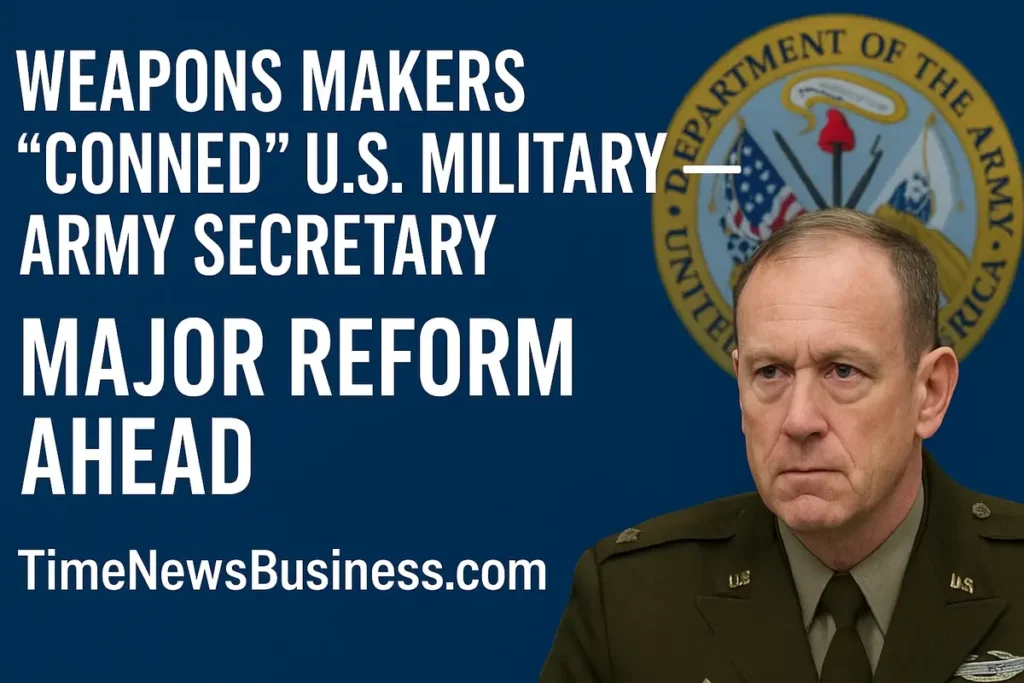
Army secretory of United States of America made a remark, that was both unusual and stunning. His bold remarks mark a turning point in the conversation about accountability, transparency, and reform within the military procurement system. Army Secretary Dan Driscoll has accused leading defense contractors of having “conned” the United States military into purchasing equipment that was outrageously expensive, even when there were options available that were more affordable.
What Was Said, and Why It Is Not Unimportant
There was no holding back from Secretary Driscoll.According to what he said, the “defense industrial base in general, and the prime contractors in particular, have deceived the American people and the Pentagon.”
He used an example, that shocked even seasoned military analysts to illustrate his point. The example was a control knob that was used in the display system of a helicopter, and cost $47,000 to produce. However, it could be made for approximately $15 using standard commercial methods. This glaring difference demonstrates how deeply flawed and overpriced the defense acquisition system has become. Comments made by Driscoll put light on the critical need for change and accountability in the area of spending on the military expenditures.
A portion of the responsibility was also placed on the government itself, as he stated that the government’s complex procurement laws and outmoded incentive systems were the reasons why inflated pricing was allowed to go unchecked for a number of years.
Possible Changes on the Horizon
Within the United States Army, preparations are now being made to revamp its procurement process in order to eradicate inefficiencies and lessen its reliance on major “prime” contractors.
What are some of the planned measures?
Increasing the use of commercial sources: The Army intends to purchase more equipment directly from the commercial market, particularly for technology such as drones or unmanned aerial vehicles.
It is possible that traditional military giants like Lockheed Martin, Boeing, RTX, and Northrop Grumman might be subject to more stringent scrutiny on contract price. This would help reduce the overall reliance on large contractors.
The procurement process will be more transparent in the future, and there will be more robust cost auditing tools to prevent markups.
The military will encourage smaller technology and industrial companies to participate in defense bids in order to reduce costs and boost innovation. This will bring about the desired effect of encouraging competition.
Secretary Driscoll also underlined the need of having a “right-to-repair” philosophy, which would enable the military to repair or modify equipment without having to rely on the original manufacturer for every single little part or software update.
A Look at the Bigger Picture:
Why This Is Important On behalf of the Defense Industry
It is important for large defense companies to take Driscoll’s comments seriously and respond accordingly. His remarks point to a potential future in which:
The pricing of every significant contract may be examined to ensure that it is fair.
Businesses who overcharge their customers or delay production run the risk of losing future business.
It is possible that long-standing conventions in the military sector might be disrupted by a change toward manufacturing that is more business-like and nimble.
What about the United States?
The United States military may be able to save billions of dollars in public money while also accelerating access to innovative technology.
However, there is also the possibility of risk: if the quick reform is not executed appropriately, it may result in difficulties in terms of logistics, have an impact on quality control, or decrease monitoring.
Nevertheless, Driscoll’s comment about the “$47,000 knob” clearly expresses the dissatisfaction that many Americans feel about waste in defense expenditure, particularly when that money might be used to increase preparedness or innovation in other areas.
For Defense Markets Around the World
The global defense market will be affected by any significant change in the manner in which the United States military purchases weapons.
There is a possibility that other countries will follow the United States’ example and reevaluate their own methods of defense acquisition.
There is the potential for atypical, smaller military suppliers to develop chances to compete on a global scale.
It is possible that traditional military firms may be compelled to reevaluate their pricing and manufacturing practices on a global scale.
The Future Holds Both Obstacles and Dangers
In spite of the fact that Driscoll’s idea has garnered attention and acclaim for its audacity, it is confronted with a number of obstacles:
Long-term contracts and established connections with large military companies will be difficult to unravel due to the resistance to change that comes from institutions.
Safety and reliability criteria: Commercial vendors are still required to fulfill the stringent safety and reliability standards set by the military.
There is a high probability that defense giants will exert significant pressure through legal and political avenues in order to push back.
However, the position taken by the Secretary of the Army indicates that change is not a choice but rather an unavoidable necessity. At this point, the focus is on striking a balance between cost efficiency and national security.
The Next Things to Watch
It is reasonable to anticipate comprehensive contract evaluations, and additional cost transparency measures during procurement audits. Congressional backing: It is anticipated that lawmakers will discuss new “right-to-repair” and defense contract reform proposals over the next few days.
In order to lessen its reliance on major primes, the United States military may decide to diversify its contracts by bringing on board other private-sector, and commercial technology businesses.
It is expected that major military companies would adjust their strategies; some of them may reduce their pricing, while others may innovate in order to justify their expenditures.
Final Thoughts
It is possible, that the forthright charge made by the Secretary of the Army that weapons manufacturers “conned” the United States military will signal the beginning of one of the most significant defense procurement shake-ups in the history of modern times.
Because of his words, long-standing inefficiencies that squander money from taxpayers and slow down the process of military modernization have been brought to light.
If the impending changes are successful, they have the potential to revolutionize the way the military does its business. This would include a transition away from expensive legacy systems and toward a procurement process that is more open, competitive, and transparent.
When all is said and done, this is not only about saving money; it is about restoring confidence, accountability, and creativity in the military system of the United States of America.