


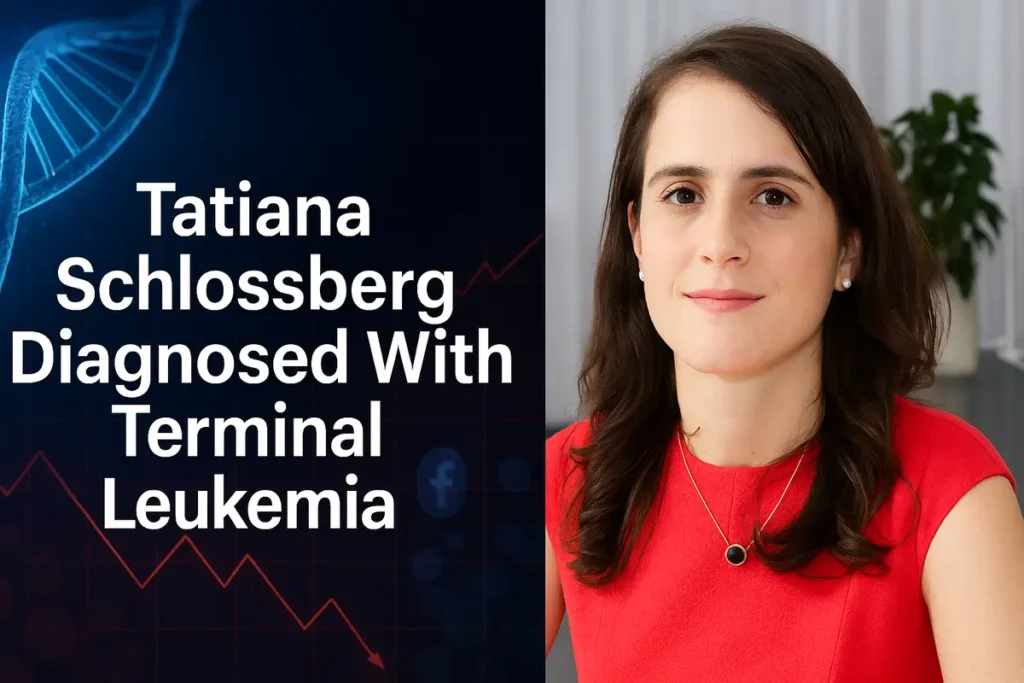
At just 35 years old, journalist and author Tatiana Schlossberg has shared devastating news: she has been diagnosed with a terminal form of acute myeloid leukemia. The granddaughter of President John F. Kennedy made the revelation in a deeply personal essay, describing how the disease was discovered shortly after the birth of her second child and how doctors have told her she may have less than a year to live. The announcement ripples far beyond her individual struggle—touching the heritage of one of America’s most storied families, raising questions about genetic risk, treatment innovation and the human cost of high-profile legacies.
The Diagnosis Unfolds
How It Was Discovered
According to her own account, Schlossberg’s ordeal began quietly. She had just given birth to her daughter in May 2024 when doctors noted an abnormal white-blood-cell count. What seemed initially a routine post-partum check turned into a full investigation. She writes that her count soared to 131,000 cells per microlitre—well beyond the typical 4,000 to 11,000 range.
Medical Details Behind the Case
Her diagnosis: acute myeloid leukemia (AML) featuring a rare genetic mutation known as Inversion 3. Despite aggressive treatment—chemotherapy, a bone-marrow transplant and even experimental CAR-T-cell therapy—doctors indicated the disease cannot be cured and gave a prognosis measured in months, not years.
Why the Mutation Matters
- Inversion 3 is more commonly associated with older adult patients, making Schlossberg’s case unusually young.
- AML in this form carries higher risk and poorer outcomes, particularly when standard therapies fail or disease recurs.
- Her decision to share the specifics places a spotlight on rare-mutation cancers and the need for tailored research.
Personal Impact and Family Legacy
Balancing Public Life and Private Pain
As the daughter of Caroline Kennedy and Edwin Schlossberg, Tatiana is accustomed to public attention. Yet nothing in her upbringing could quite prepare her for this. She recounts the shock of being physically active and healthy one moment—swimming a mile while nine months pregnant—and being told the next that her life is now “terminal”.
“I did not–could not–believe that they were talking about me.”
Those words resonate strongly, coming from someone whose family history includes trauma and scrutiny.
Family and Children in Focus
Schlossberg is married to George Moran, a physician, and the couple have two young children. In her essay she reflects on the agonising prospect of her son and daughter growing up without memories of her and sees the diagnosis as a new tragedy added to a family already marked by loss. Her brother, Jack Schlossberg, running for Congress, responded publicly with support; the Kennedy extended family and close friends have rallied behind her.
The Kennedy Factor: Tragedy, Public Service and Genetics
The Kennedy name carries profound weight in American cultural memory. It evokes public service, tragedy and resilience. Tatiana commented on how this latest diagnosis might fit into perceptions of a “Kennedy curse”—though she clarifies the nuance and avoids sensationalism. Her openness about her illness highlights not just the legacy, but the very real human life behind the headlines.
Treatment Path and Medical Challenges
What She Underwent
- Five-week hospital stay following diagnosis.
- Intensive chemotherapy administered at home.
- Bone-marrow transplant.
- Enrollment in a clinical trial for CAR-T-cell therapy.
- Continued monitoring and palliative planning once curative options were exhausted.
The Prognosis and Limits of Current Therapies
Despite her access to top-tier medical care, Schlossberg’s doctors advised that the disease is incurable under current standards. The question shifts from remission to how to live meaningfully in the time available.
Broader Significance for Rare Mutations
Her public disclosure may catalyse:
- More research funding into rare AML subtypes and young‐onset cases.
- Enhanced transparency around prognosis communication for high-risk patients.
- Greater awareness of the psychosocial dimension of terminal diagnoses among younger adults.
Public Response and Media Coverage Reaction From the Kennedy Community and Beyond
Messages of support poured in from fellow public-figures, researchers and cancer-advocacy groups. The announcement also punctured a private-family moment with deeply public ramifications—highlighting how celebrity illness can galvanise awareness.
Debate Around Disclosure and Privacy
Some commentators raised questions: How much detail to share publicly? What is the role of media when a prominent individual faces terminal prognosis? Schlossberg’s decision to publish a candid essay points to evolving norms around illness narratives and transparency.
What This Means for Younger Patients
- Younger adults are less often prepared for terminal diagnoses—it’s typically associated with older age.
- The presence of small children intensifies the emotional and logistical burden.
- Public figures like Schlossberg can open doors for discussions on work-life-health balance, financial planning, estate planning and legacy in ways that many non-celebrities cannot.
Wider Implications: Health, Research and Legacy
Research Priorities
Schlossberg’s case underscores several broader research priorities:
- Targeted therapies for AML with poor-prognosis mutations.
- Age-specific models of care for younger adults diagnosed with serious cancers.
- Psychosocial models for supporting families when the patient is both caregiver and parent.
Health-system Reflections
Her essay does more than recount personal suffering—it raises systemic questions: access to cutting-edge therapies, the pace of clinical breakthroughs, and how health systems handle rare cancers. The intersection of being a mother, journalist and part of a renowned family adds layers to this reflection.
Legacy Considerations
For Tatiana, her legacy is likely to shift from environmental journalist and author to someone defined by how she managed this final chapter. Her family’s public service ethos may frame her illness in a new light: not as tragedy alone, but as a moment of truth, openness and potential inspiration for other patients.
Key Facts & Figures
- Age: 35 years.
- Diagnosis: Acute myeloid leukemia (AML) with Inversion 3 mutation.
- Discovery: Post-partum May 2024 following second child’s birth.
- Treatment: Chemotherapy, bone-marrow transplant, CAR-T-cell trial.
- Prognosis: Doctors estimate less than one year to live.
- Family: Husband George Moran; two children; parents Caroline Kennedy and Edwin Schlossberg; brother Jack Schlossberg.
What to Watch Next
- Will further medical updates be shared publicly and how will they affect awareness campaigns?
- Will the diagnosis prompt increased research funding or advocacy groups for young-adult rare leukemias?
- How will Schlossberg’s family, especially her children, cope in the years ahead, and what models of support may emerge?
- Will the broader public discourse shift around terminal illness among younger adults, especially those with high-profile or caregiving roles?
Conclusion
Tatiana Schlossberg’s revelation of a terminal leukemia diagnosis at 35 is both heart-wrenching and profoundly instructive. It reminds us of the fragility of life, even within storied families, and the critical gaps that still exist in cancer research, treatment and psychosocial support for younger adults. Her decision to share her journey opens a window into a world few outside elite circles ever glimpse—and in doing so, she may help lay clearer paths for others.
Amid the weight of her family legacy, Schlossberg faces one of life’s harshest realities with clarity and courage. Her story is not simply about one illness, but about how we, as a society, face mortality, memory, service and hope.