


Introduction
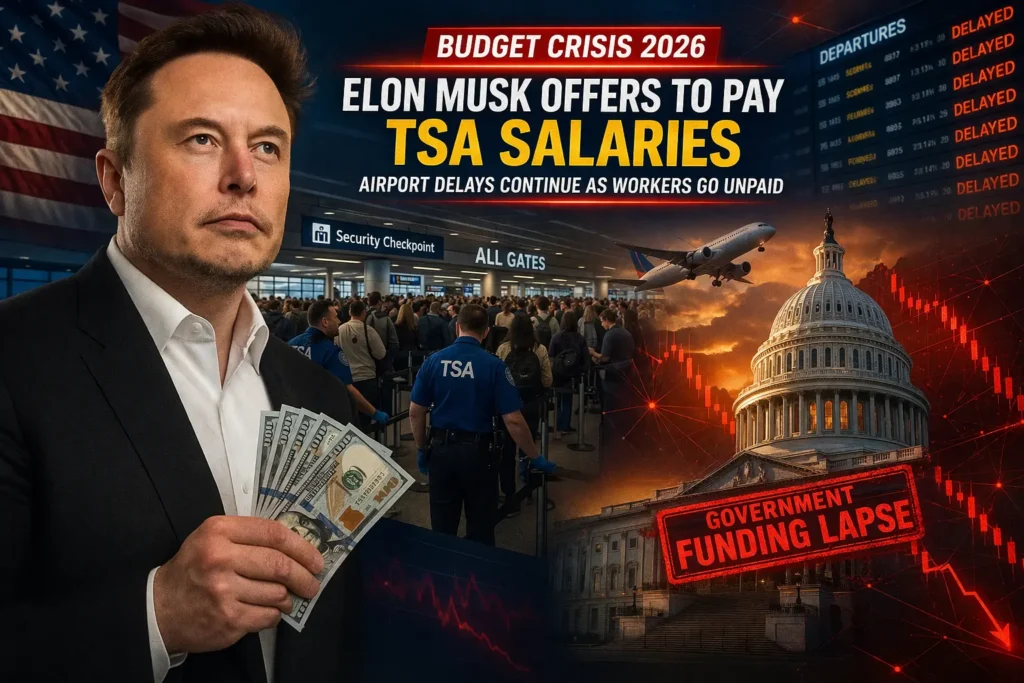
A dramatic development has been witnessed in the ongoing U.S. government funding crisis, as billionaire entrepreneur Elon Musk has offered to pay the salaries of Transportation Security Administration (TSA) workers. The proposal has been made during a prolonged budget impasse that has disrupted airport operations and left thousands of security personnel working without pay.
The situation has been widely viewed as a reflection of deep political divisions and operational challenges within the U.S. government. Meanwhile, travelers across the country have been experiencing long delays, highlighting the broader impact of the crisis.
Background of the Budget Impasse
The current disruption has been caused by a funding lapse affecting the Department of Homeland Security (DHS), under which the TSA operates. The impasse has continued for several weeks, during which negotiations in Congress have failed to produce a final agreement.
It has been reported that TSA officers, who are classified as essential workers, have been required to continue their duties despite not receiving salaries. This situation has been repeated within a short span of time, making it the second such unpaid period in recent months.
As a result, airport security operations have been strained, and public frustration has been increased significantly.
Elon Musk’s Offer and Its Implications
In response to the crisis, Elon Musk announced through his social media platform that he would be willing to cover the salaries of TSA personnel during the funding gap. The statement has been interpreted as an attempt to ease the burden faced by workers and reduce disruptions for travelers.
However, the proposal has not yet been formally accepted or implemented. Legal experts have indicated that the payment of federal employees by a private individual may face regulatory and constitutional challenges.
Public and Political Reactions
The offer has generated mixed reactions across political and public spheres. While some have viewed it as a generous intervention, others have questioned its feasibility and long-term implications.
It has also been noted that no official response has been issued by DHS or TSA authorities regarding the proposal.
Impact on TSA Workers
H3: Financial Hardship
The financial condition of TSA employees has been significantly affected. Many workers have been reported to be living paycheck to paycheck, making the absence of income particularly challenging.
It has been observed that food drives and donation programs have been organized at several airports to support affected employees.
Workforce Shortages
Due to the ongoing crisis, a noticeable increase in absenteeism has been recorded. Additionally, hundreds of TSA officers have reportedly resigned during the shutdown period, further weakening operational capacity.
The average salary of TSA personnel, which is estimated to be around $61,000 annually, has been insufficient to sustain workers without regular payments.
Airport Disruptions and Passenger Experience
Long Security Lines
Passengers at major U.S. airports have been facing extended wait times, sometimes stretching into hours. These delays have been attributed to reduced staffing levels and increased absenteeism among TSA officers.
Operational Challenges
Airlines and travel groups have warned that the situation could worsen if the funding dispute is not resolved soon. The operational efficiency of airport security systems has been compromised, raising concerns about both convenience and safety.
Political Tensions and Alternative Proposals
The funding crisis has been closely linked to broader political disagreements over immigration policies and DHS operations. Lawmakers have remained divided, preventing a swift resolution.
Proposal to Deploy ICE Agents
In a controversial move, U.S. President Donald Trump suggested that Immigration and Customs Enforcement (ICE) agents could be deployed to airports to fill staffing gaps.
This proposal has been strongly criticized by opposition leaders and civil rights groups, who have argued that ICE agents are not trained for airport security roles.
Legal and Practical Challenges
Can Private Funding Replace Government Pay?
The idea of a private individual funding federal salaries has raised significant legal questions. It has been suggested that existing laws may prohibit such arrangements, as government employees are typically paid through federal appropriations.
Logistical Barriers
Even if legal hurdles were addressed, practical challenges such as payroll distribution, accountability, and oversight would need to be resolved. These complexities have made the implementation of Musk’s proposal uncertain.
Broader Economic and Social Implications
The ongoing situation has highlighted vulnerabilities within essential public services during government shutdowns. It has been observed that repeated funding lapses can lead to long-term damage, including reduced workforce morale and increased attrition.
Public Confidence at Risk
The inability to maintain smooth airport operations has also affected public confidence in government systems. Travelers have been increasingly frustrated, and concerns about national security have been raised.
Future Outlook
Negotiations in Congress have continued, with bipartisan efforts being made to resolve the funding dispute. However, no final agreement has yet been reached, leaving uncertainty over when normal operations will resume.
Possible Scenarios
- A funding agreement could be finalized, restoring salaries and stabilizing operations
- Temporary measures, such as emergency funding, might be introduced
- Continued delays could worsen staffing shortages and disruptions
Conclusion
The offer made by Elon Musk has brought global attention to the challenges faced by TSA workers during the ongoing budget crisis. While the proposal has been viewed as an extraordinary gesture, its practical implementation remains uncertain.
The situation has underscored the critical role played by TSA personnel in maintaining airport security and the significant consequences that arise when government funding is disrupted.
Until a resolution is achieved, airport operations are expected to remain under pressure, and the hardships faced by workers are likely to continue.