


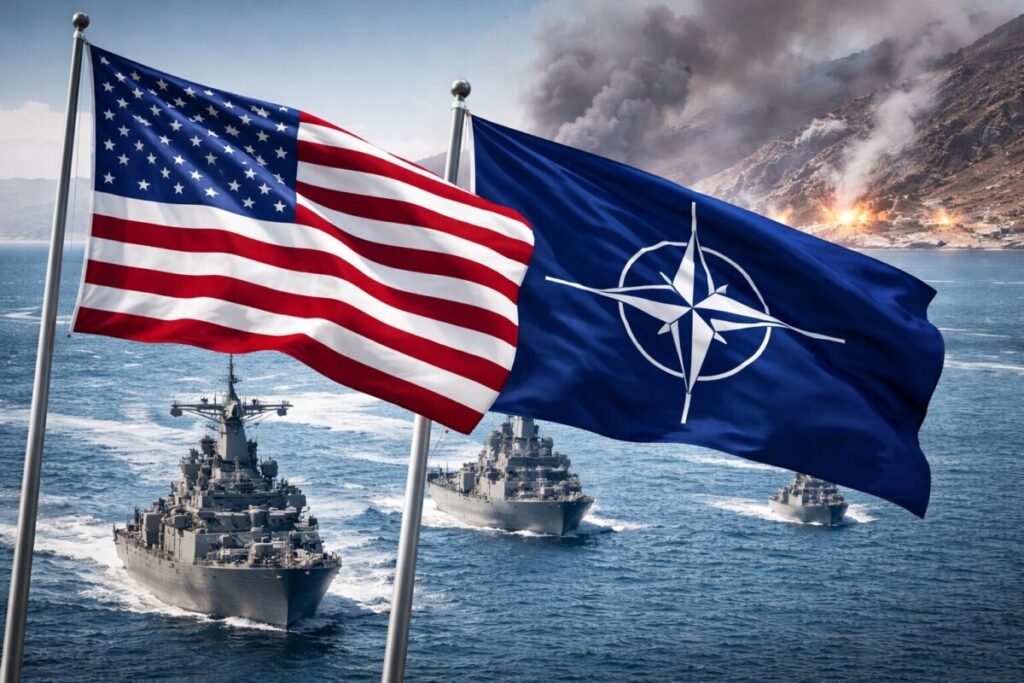
A renewed sense of urgency has been introduced into transatlantic relations after fresh demands were conveyed by the United States regarding the security of the Strait of Hormuz. According to diplomatic sources, United States allies within NATO have been informed that concrete commitments are expected within days. The development has been viewed as a reflection of rising tensions within the alliance, alongside the broader geopolitical crisis unfolding across the Middle East.
The message was delivered following a high-level meeting held in Washington between NATO Secretary General Mark Rutte and U.S. President Donald Trump. The discussions raised concerns about the ongoing instability in the Strait of Hormuz, a critical global shipping route. The expectation of immediate action from NATO members was clearly communicated.
Pressure Builds Over Strategic Waterway
The Strait of Hormuz has long been recognized as one of the world’s most vital maritime chokepoints. This narrow passage transports a significant portion of global oil shipments. Recent conflict developments have already reported disruptions, and the situation remains fragile.
As tensions escalated following military actions involving Iran, the need to ensure freedom of navigation has been emphasized. It has been indicated that Washington expects its allies to take a more active role in safeguarding maritime traffic. However, NATO as an organization has not been directly involved in the conflict.
Diplomats say the demand for commitments is due to concerns that the US has shouldered too much of the security burden. A stronger contribution from European allies has therefore been requested.
NATO Faces Internal Divisions
NATO has observed differing views regarding its involvement in the crisis. Many European countries have expressed reluctance to participate in military operations related to the Iran conflict. Instead, diplomatic solutions have been preferred.
The alliance has traditionally maintained a defensive mandate, focusing primarily on Euro-Atlantic security. Consequently, member states have often approached participation in external conflicts with caution. Legal, political, and public opinion concerns across several member states have reinforced hesitation in this case.
Despite these reservations, discussions have been ongoing about potential support measures. These have included maritime patrols, logistical assistance, and post-conflict stabilization efforts. However, no unified approach has yet been finalized.
Trump’s Frustration with Allies Highlighted
President Trump has repeatedly expressed frustration with NATO’s response to the crisis. The alliance has been criticized for what has been described as insufficient support. Strong language has been used in public statements, and the organization has even been labeled ineffective.
Threats of a potential U.S. withdrawal from NATO have also been raised once again. Although such a move would face legal and political obstacles, the possibility has added to uncertainty within the alliance.
The U.S. administration argues that European nations have heavily relied on American security guarantees while contributing less to joint military efforts. This issue has remained a longstanding point of contention and has now resurfaced in the context of the Hormuz crisis.
Diplomatic Efforts Continue Behind the Scenes
Efforts to manage the situation have been actively pursued by NATO leadership. Mark Rutte has played a mediating role by maintaining communication with both Washington and European capitals.
The United States has acknowledged that it takes the concerns seriously. At the same time, the importance of maintaining alliance unity has been emphasized. Diplomatic engagement has therefore been prioritized to avoid further escalation.
Parallel initiatives have also been launched outside NATO frameworks. A coalition led by countries such as the United Kingdom and France has been working on proposals aimed at reopening and securing the Strait of Hormuz. These efforts have involved discussions with multiple nations and have focused on both military and diplomatic strategies.
Impact of the Iran Conflict
The current situation has been shaped significantly by the broader conflict involving Iran. Military strikes and countermeasures have resulted in disruptions to shipping and energy supplies. At one point, the conflict significantly reduced traffic through the strait, leading to a sharp increase in global oil prices.
Under a fragile ceasefire agreement, limited passage through the strait has been allowed. However, strict controls have been imposed, with only a small number of vessels permitted to transit daily.
The uncertainty surrounding the ceasefire has added to concerns about long-term stability. It has been widely believed that without a broader agreement between Washington and Tehran, lasting security cannot be achieved.
Europe Caught Between Strategy and Caution
These developments have put European allies in a challenging situation. On one hand, the importance of the Strait of Hormuz for global trade and energy security has been recognized. On the other hand, direct involvement in the conflict has been viewed as risky.
Public opinion in many European countries has also influenced decision-making. Skepticism about the legitimacy and consequences of the Iran conflict has been reflected in political debates. As a result, governments have proceeded cautiously.
Some countries have indicated willingness to contribute to post-conflict security arrangements rather than immediate military action. This approach has been seen as a compromise between supporting allies and avoiding escalation.
Future of NATO Under Scrutiny
The current crisis has raised broader questions about the future of NATO. The alliance has been tested not only by external threats but also by internal disagreements. The balance between collective defense and individual national interests has been brought into focus.
It has been suggested by analysts that the situation could lead to changes in how NATO operates. Greater emphasis on burden-sharing and strategic coordination may be required. At the same time, the importance of maintaining strong transatlantic ties has been highlighted.
The role of the United States within NATO has also been closely examined. While Washington remains the alliance’s most powerful member, its expectations of partners have continued to evolve.
Uncertain Path Ahead
As the deadline for commitments approaches, uncertainty has remained high. It has not been confirmed what form the expected commitments will take. Diplomats have indicated that initial steps may be symbolic, with more substantial measures to follow later.
The outcome of ongoing discussions will likely determine the next phase of the crisis. If consensus can be reached, coordinated efforts to secure the Strait of Hormuz may be implemented. If not, divisions within NATO could deepen further.
In the meantime, the situation in the Middle East continues to be closely monitored. The stability of global energy markets, international shipping routes, and geopolitical alliances all remain at stake.