


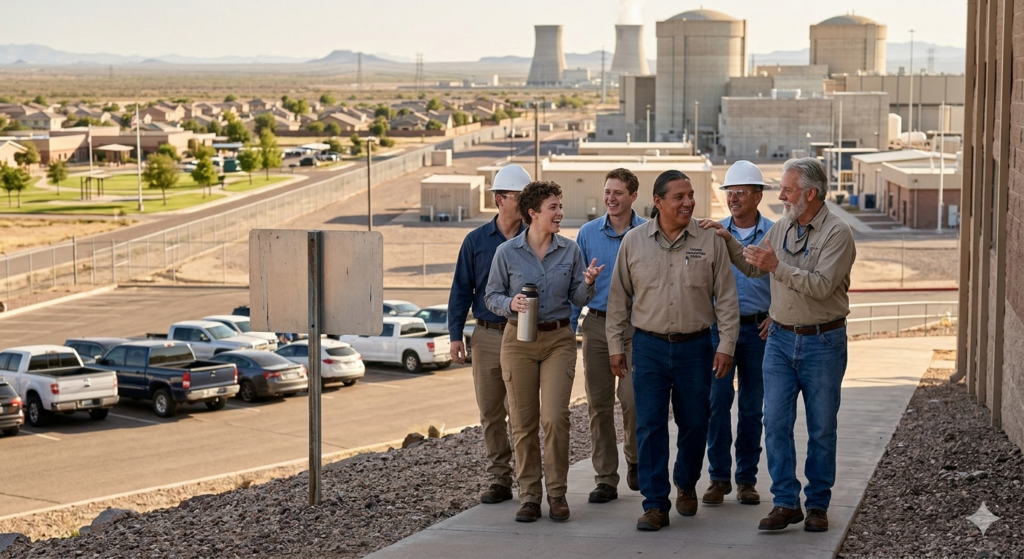
As local officials across the country search for new ways to create jobs in their communities, a new generation of nuclear reactors—called Small Modular Reactors (SMRs)—is emerging as a promising opportunity to site reliable, baseload power in rural areas and deliver exactly what communities are looking for: high-quality, good-paying jobs.
Arizonans already understand the powerful economic benefits of nuclear. The Palo Verde Nuclear Generating Station, the largest clean-energy producer in the West, employs roughly 2,500 full-time workers, many of whom earn more than $100,000 a year plus benefits. About one-third of its employees are veterans, and many are also skilled tradesmen and technicians. These are stable, career-track jobs that support families, strengthen local economies, and help build a strong middle class—demonstrating how a single facility can serve an entire community.
Labor organizations across the country recognize the valuable employment benefits of nuclear power. The Arizona Building & Construction Trades Council, for example, recognizes Palo Verde as one of the state’s “signature projects,” while labor unions such as IBEW, Boilermakers, Pipefitters, Ironworkers, and LIUNA all support nuclear as a source of durable employment that provides dignified work for Arizona communities.
Now, with the rapid development of SMR technology, the ability to expand those opportunities to rural areas is becoming even easier.
SMRs are designed to deliver the same reliable power and workforce benefits of traditional reactors but with greater flexibility in where and how new plants are built. Their smaller size, modular construction, and advanced safety features make them especially attractive for rural communities that are looking to create high-quality jobs.
Like traditional nuclear facilities, SMRs require a highly skilled workforce. A typical 300-megawatt SMR unit needs roughly 150 to 250 permanent employees, many in engineering, operations, maintenance, and skilled trades. These are long-term positions that offer strong wages, technical training, and stable career pathways.
Projects already underway across the country show what this opportunity can look like. TerraPower’s new reactor project in Wyoming is expected to employ more than 250 workers, many earning six-figure salaries. The Tennessee Valley Authority’s project at Clinch River is expected to bring more than 300 jobs, while X-energy’s project in Texas anticipates about 100 permanent positions once operations begin.
As the president of the North American Building Trades Unions recently said, the TerraPower project represents a “massive step forward for workers and their families … with strong middle-class, family-sustaining jobs.”
In addition to supporting a skilled workforce, SMRs are designed with features that make them well suited for a wide range of communities. Their compact footprint—often requiring only about 10 to 15 acres per unit—means they can be deployed efficiently in rural areas without negatively impacting surrounding land and open space, while their modular design allows major components to be manufactured in factories and transported to the site, creating greater deployment options for rural areas. Lastly, many designs incorporate passive safety features that make them “meltdown proof” and “walk-away safe,” often allowing emergency response radii to shrink from tens of miles to not more than the site’s perimeter.
For rural communities across the West, these advanced nuclear innovations represent a powerful opportunity to write the next chapter of rural America’s story.
By choosing to site SMRs in rural areas, local officials can not only generate clean and reliable power for the state, but help revitalize local communities and create hubs for new economic development, providing high-paying jobs and opportunities for the next generation of skilled workers.
Let’s support the strategic deployment of advanced nuclear reactors in our state to honor the dignity of work, support rural communities, and unleash economic prosperity for the American middle class.
Michael Carbone is a Republican member of the Arizona House of Representatives representing Legislative District 25 and serves as House Majority Leader. Follow him on X at @MichaelCarbone.