

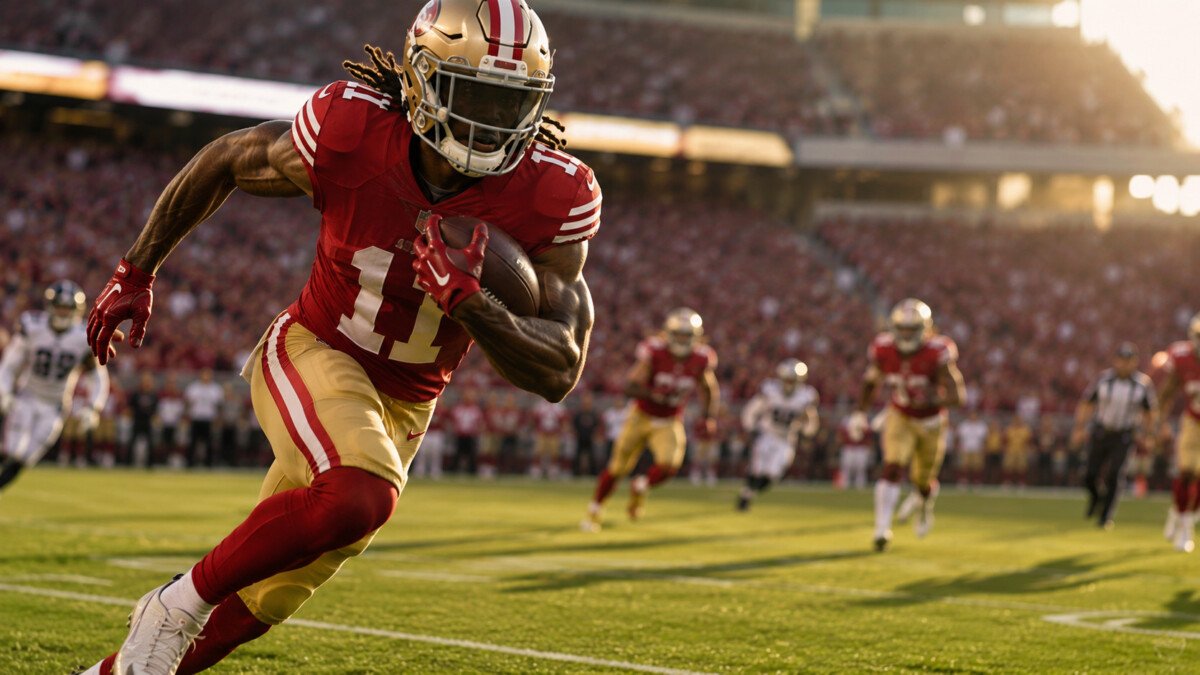
Not many offseason sagas dragged out quite like this one, and it’s finally over. After nearly five months on the open market with no takers, Deebo Samuel is heading back to San Francisco. And make no mistake — this wasn’t a feel-good homecoming. Something more pressing forced the 49ers’ hand, and what it says about their receiver room is worth paying attention to.
Let’s break down what this reunion actually means.
A Familiar Face, A Familiar Offense
Word broke on July 31, 2026, that Samuel was returning to the 49ers — and the timing wasn’t a coincidence. Injuries had gutted the wide receiver corps, San Francisco suddenly needed a proven pass-catcher, and one just happened to be sitting there available.
Samuel got traded to the Commanders last offseason, but the move never really clicked in Washington. He stayed mostly healthy, sure, but he limped to just 727 receiving yards by season’s end — a shadow of what he’d once done in a 49ers uniform.
And what he did in that uniform was special. Rewind to 2021, when Samuel torched defenses for 1,405 receiving yards and turned himself into one of the scariest dual-threat weapons in football. Nobody’s expecting that Deebo this time. What they want is a sharper, more focused role — one that plays to how well he already knows this offense.
The Contract: A Cheap, Smart Gamble
The money tells you exactly how San Francisco is thinking about this. Per NFL Network’s Ian Rapoport, Samuel is signing a one-year deal worth up to $7 million.
That’s a flexibility play, plain and simple. A short, incentive-heavy contract protects the team while giving the player a stage to prove he’s still got it. At 30, Samuel spent close to five months unsigned after that disappointing year in Washington. Whatever interest came his way over the summer, none of it was enough to pull the trigger.
Still, an opening was always going to show up eventually. Once training camps kicked off and receivers started dropping like flies around the league, it was only a matter of time before a needy team came knocking. The 49ers turned out to be one of the hardest hit — so the fit made sense for everybody. And for Samuel, the motivation is obvious: ball out here, and a bigger multi-year payday could be waiting next spring.
Why This Was Basically a No-Brainer
Look closely and you realize this signing came from need, not luxury.
Samuel brings a lot to the table. For starters, he’s got six years in Kyle Shanahan’s system, which means barely any learning curve. When a lot of receivers need weeks just to grasp the playbook, a guy you can drop in immediately is gold.
Then there’s his versatility. Back in his first go-round with the team, Shanahan loved lining him up in the backfield for gadget stuff, and that all-over-the-place usage could come roaring back once the room gets healthy. A weapon you can move around the formation gives a play-caller options most rosters can only dream about.
One more thing worth noting: yes, injuries have followed Samuel throughout his career, but he held up just fine in 2025. For a team currently getting bitten hard by the injury bug, that’s reassuring.
How the WR Depth Chart Shakes Out
To get why Samuel was needed, you’ve got to look at the pecking order.
Up top, Mike Evans and Ricky Pearsall are the projected starters, with veterans Christian Kirk and Samuel right behind them. Second-round rookie De’Zhaun Stribling is in the mix too, along with a pile of camp bodies — Demarcus Robinson, Jacob Cowing, Jordan Watkins, Junior Bergen, Malik Turner and others all scrapping for roster spots.
On paper? Looks deep. In reality, the moment concern started swirling around Pearsall, the need for a legit proven option shot up fast. Adding Samuel takes some heat off Evans and Kirk and — maybe more importantly — keeps Stribling from being thrown into a huge role before he’s ready. A rookie you can bring along slowly tends to develop a whole lot better than one you’re forced to lean on out of desperation.
The Injuries Behind It All
You can’t separate this signing from the mess that triggered it, and the details aren’t pretty.
The big worry is Ricky Pearsall, who’s dealing with swelling tied to a PCL knee injury that goes back to last season. The team is reportedly exploring all its options, and if he ends up needing surgery, he could lose the entire year. That’s a gut punch for a guy who was supposed to take a step forward.
Pearsall isn’t the only issue, either. Christian Kirk popped up with a calf problem early in camp — nothing serious, they think — and tight end George Kittle is still grinding back from a torn Achilles that could sideline him to start the regular season. When one of the best tight ends in the game and a rising receiver are both in doubt, the passing attack gets awfully thin awfully quick. That’s exactly the hole Samuel is here to plug.
And it’s not just the receivers. A handful of other regulars have gone down in the opening practices too: safety Malik Mustapha (hamstring), running back Jordan James (fractured rib), offensive tackle Vederian Lowe (high ankle sprain) and defensive tackle Gracen Halton (knee). When the injuries pile up like that in the first few days of camp, you understand why the front office moved fast to grab a veteran safety net.
What to Expect Going Forward
So how should we grade this reunion? Honestly, think of it as a smart, cheap insurance policy — not some blockbuster splash.
Nobody’s chasing the 2021 ceiling here. What San Francisco wants is dependability, scheme knowledge and flexibility from a guy who can contribute on day one without needing to be taught anything. If he stays healthy and rediscovers even a slice of that old versatility, this’ll go down as a clear win.
For Samuel, it’s personal. He’s getting a shot to rebuild his value in the one place that’s always understood how to use him best. Take advantage of it, and that bigger payday swings back into view next year.
The Bottom Line
The Deebo Samuel–49ers reunion is really just necessity bumping into opportunity at the perfect moment. A banged-up receiver room needed help, a talented veteran needed a reset, and the two found each other right on time. Whether it becomes a footnote or a turning point comes down to what happens on the field. For now, though, a familiar face is home, and a battered San Francisco offense just bought itself a little breathing room.