

How the IKEA Buy Back & Resell Program Works
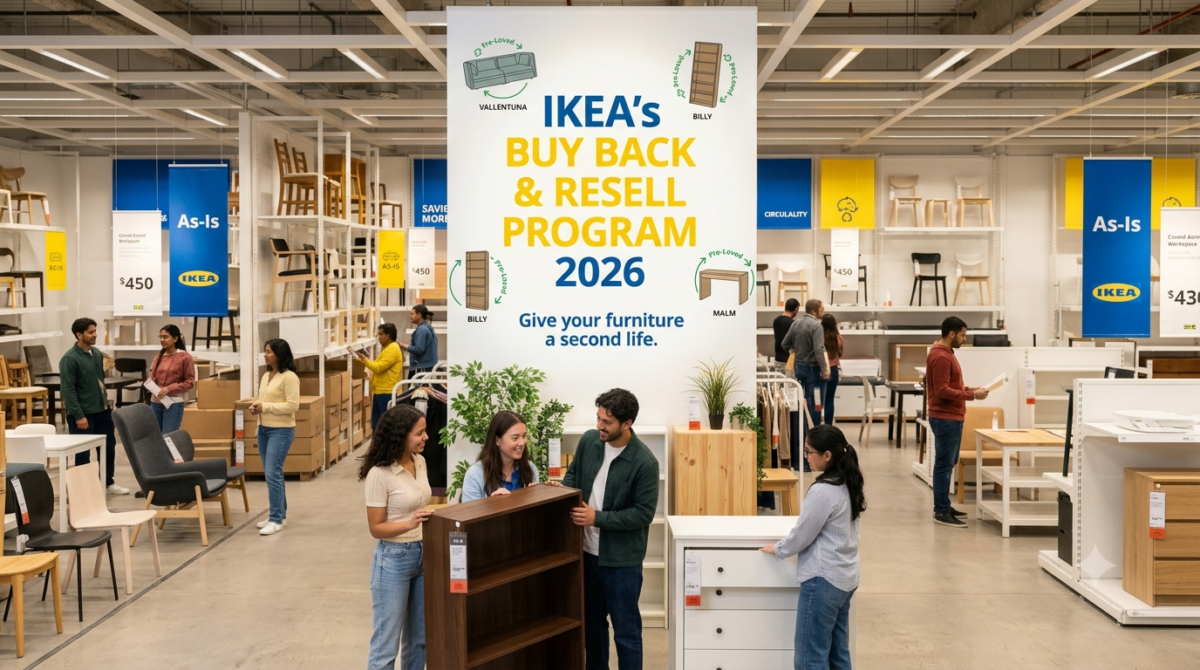
The mechanics of the IKEA Buy Back & Resell program are elegantly simple, which is part of why it has taken off so dramatically. A customer visits IKEA’s website, submits a few photos and details about the piece they want to sell, and receives a preliminary estimate. They then bring the furniture to a local store, where staff inspect it. Once accepted, the item earns the seller store credit — with the requirement that they belong to the free IKEA Family or IKEA Business Network. The real genius shows in the pricing structure of the IKEA Buy Back & Resell program. Condition is everything. At the Washington, D.C., location, a large black Kallax shelf unit displaying minor scratches was recently bought back for $69.65. A near-mint version fetched roughly $10 more, while a heavily used example came in about $10 less. Considering that same shelf retails new for nearly $300, the IKEA Buy Back & Resell program instantly becomes an attractive proposition for anyone looking to upgrade without waste. Once the furniture is back in IKEA’s hands, it gets cleaned, repaired if necessary, and moved to the As-Is section, where it typically sells within 48 to 72 hours — a velocity that underlines just how fierce demand for affordable pre-owned pieces has become.
The Surprising Demographics Drawn to the IKEA Buy Back & Resell Program
When IKEA first began piloting the Buy Back & Resell program, the assumption was that it would primarily attract budget-conscious families and students. That audience showed up in force, but the IKEA Buy Back & Resell program also unlocked a completely unexpected market: design aficionados, vintage collectors, and people hunting for pieces no longer found in the glossy showroom. Some stores have taken in high-ticket items like a $2,000 Stockholm collection sofa, and the oldest piece ever accepted through the IKEA Buy Back & Resell program was a postmodern Signatur executive desk from the 1980s. Bryan Walker, product quality manager for IKEA U.S., observed, “I can’t have a conversation about secondhand without talking about affordability. But we’re also seeing people come in looking for unique pieces they can’t find in the showroom anymore.” The IKEA Buy Back & Resell program, in other words, has become a treasure hunt that cuts across income levels and design sensibilities.
Loyalty and Commercial Gains Report
The business case for the IKEA Buy Back & Resell program becomes unassailable when you examine customer behavior after a transaction. Walker noted that participants in the buyback program visit IKEA stores 50 percent more often in the six months following their sale. When you broaden the lens to include both buyback sellers and secondhand buyers, the IKEA Buy Back & Resell program drives 1.6 times more store visits than the average IKEA Family member generates. Crucially, selling used Billy bookcases and Poäng chairs does not steal sales from new inventory; instead, the IKEA Buy Back & Resell program pulls in fresh customers looking for lower entry prices, many of whom end up spending well beyond the value of their store vouchers. Global participation numbers tell the same story: over 211,600 customers used the IKEA Buy Back & Resell program in 2023, double the previous year’s figure. In the U.S., buybacks climbed from 8,000 items in 2023 to 14,700 in 2025, and since the program’s inception, roughly 53,000 pieces have been recovered. The IKEA Buy Back & Resell program has quietly transformed from a sustainability side project into a genuine growth engine.
Sustainability Milestones Woven into this Program
Every transaction in the IKEA Buy Back & Resell program is a direct push against a staggering statistic: the Environmental Protection Agency estimates that Americans send 9 million tons of furniture to landfills each year. By keeping products in circulation, the IKEA Buy Back & Resell program materially reduces that waste stream. It also locks into the company’s ambitious pledge to design all products for reuse, repair, resale, or recycling by 2030. Globally, Ingka Group, IKEA’s largest franchise operator, sourced nearly 690,000 used IKEA products for resale last year. Closer to home, in fiscal 2025, IKEA distributed more than 373,000 spare parts — screws, knobs, hinges — to customers, a repair-first instinct that extends the lifecycle that the IKEA Buy Back & Resell program celebrates. The financials don’t suffer for all this green ambition; the company reported a 24.3 percent reduction in its climate footprint alongside 30.9 percent revenue growth in 2023. The IKEA Buy Back & Resell program makes it plain that sustainability and commercial success can run on the same track.
Meaning for the Furniture Industry
No other major furniture retailer currently operates anything like the IKEA Buy Back & Resell program, a fact that gives the company a significant first-mover advantage as the global secondhand furniture market swells toward a projected $43 billion by 2030. The initiative rewires the traditional linear model — make, sell, dispose — into a circular one that keeps products inside the IKEA ecosystem. With the September 2026 expansion, the IKEA Buy Back & Resell program becomes available to every IKEA customer in America, completing a journey that began with a single-store pilot in Conshohocken, Pennsylvania. Alongside its growing peer-to-peer Preowned platform in Europe, IKEA is building a recommerce infrastructure that turns old furniture into a currency of loyalty and foot traffic. The next phase for the IKEA Buy Back & Resell program focuses on operational fine-tuning, adding eligible categories, and deeper digital integration, but the signal is already unmistakable: a massive global retailer has figured out how to profit from taking back what it once sold, and the rest of the industry will be watching closely.