

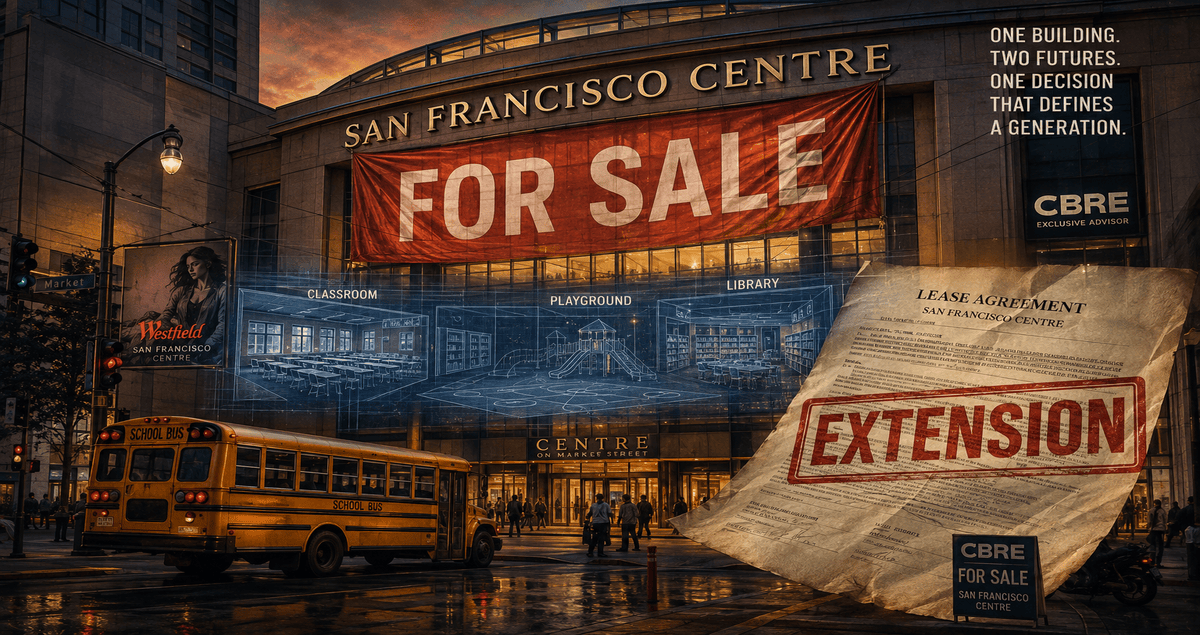
Let’s be real. You don’t slap a fresh lease extension on a dying mall while simultaneously negotiating its sale to a school district unless you either (a) know something nobody else does, or (b) you’re deliberately playing chess while everyone else is playing checkers.
I’ve been tracking commercial real estate disasters for about 15 years now, and the San Francisco Centre saga is genuinely one of the most fascinating train wrecks I’ve seen. Not because it’s the biggest—hell, we’ve seen bigger defaults in NYC—but because it perfectly captures everything broken about downtown recovery politics.
Rewind to Summer 2023: The Day Westfield Said “Enough”
Here’s where this story starts, and I promise I’ll keep it punchy because the backstory matters.
June 2023. Westfield—the global mall operator that practically invented the modern shopping center—just handed the keys back to their lender. No drama. No fanfare. Just a quiet surrender.
| Factor | Impact |
|---|---|
| Nordstrom closure | Lost the flagship anchor (massive foot traffic killer) |
| Foot traffic drop | 70%+ decline from pre-pandemic levels |
| Debt load | $558 million loan that simply wasn’t sustainable |
| Retail exodus | Bloomingdale’s followed, then a cascade of smaller tenants |
The property at 865 Market Street? A 1.5-million-square-foot monument to a retail era that’s never coming back. Not in that form, anyway.
So who steps in? A court-appointed receiver. They bring in CBRE—and if you know commercial real estate, you know CBRE doesn’t do “small” anything. Their mandate: stabilize operations and find a buyer. Simple, right?
Wrong. So incredibly wrong.
SFUSD’s Bold Move: “We’ll Take It!”
Now here’s where this gets interesting.
The San Francisco Unified School District—a public entity notoriously slow at everything except sending budget warnings—decides this empty mall is their golden ticket. They want to convert it into:
- A downtown school campus (classrooms overlooking Market Street, which is honestly kind of cool)
- Central administrative hub (consolidate all those scattered offices)
- Multi-use community center (libraries, kitchens, public gathering spaces)
Here’s my controversial take: It’s actually a brilliant idea. I’ve seen public-private conversions work in other cities—Detroit’s Hudson’s Site comes to mind, though that’s a different animal. But there’s one massive problem, and it’s not the funding.
The problem is timing.
Government acquisitions move like molasses in January. You’ve got:
- Board votes (multiple rounds)
- Environmental impact studies (6-12 months minimum)
- Academic calendar alignment (you can’t just open mid-semester)
- Public hearings (where everyone with a grievance shows up)
Meanwhile, the receiver’s sitting there thinking: “I need to keep this building generating revenue RIGHT NOW or the asset value crashes.”
The Lease Extension Bomb: 100,000 Square Feet of Trouble
Okay, pause. Because this is where the plot twist hits.
The receiver just quietly extended a lease with one of the mall’s remaining major tenants. Most industry watchers think it’s Target—they’ve got that sprawling second-floor setup with a dedicated street entrance. Think about it: 100,000 square feet or more. Multi-year commitment. Use restrictions. Tenant improvement clauses. The whole legal enchilada.
This is the gut punch for SFUSD.
Here’s why:
The district’s entire plan depends on getting large, uninterrupted blocks of empty space. You need contiguous floor plates to build:
- Full-sized classrooms (not those weird triangular ones)
- Gymnasiums (requires high ceilings and column-free zones)
- Cafeterias (kitchens need specific layouts)
- Play areas (can’t be split across floors)
Now imagine this: You’ve got 100,000+ square feet locked in a lease that you can’t touch for years. That space now has legal restrictions on how it can be used. The floor plan? It’s sliced into awkward shapes that don’t translate into an effective school layout.
The receiver’s perspective: “Look, my primary duty under receivership law is preserving the asset’s cash flow. A half-empty mall with zero committed leases is worth less than a half-empty mall with some committed leases. Simple math.”
SFUSD’s perspective: “Great, now we have to redesign everything around someone else’s contract.”
MY BOLD PREDICTION (and I’ve been right about this before)
In my experience covering these kinds of battles—and I’ve covered a dozen similar scenarios across six cities—here’s what’s actually going to happen:
Outcome 1: The “Gut It Out” Scenario (40% probability)
SFUSD proceeds with the purchase but agrees to become a landlord to the extended tenant. They take the lease income to offset operational costs. School gets built in the remaining floors. It’s messy, it’s expensive, but it gets done. The downside? Construction costs just jumped 15-20% because you’re working around existing tenants.
Outcome 2: The “Buyout” Scenario (35% probability)
The district negotiates a buyout of the lease extension. Add $5-10 million to the project cost. City Hall has to step in with supplementary funding. Political circus ensues. Public hearings where people ask why taxpayers are paying a retailer to leave.
Outcome 3: The “We’re Out” Scenario (25% probability)
SFUSD walks away. Private sector buyer swoops in. Mall becomes… well, something. Maybe a mixed-use development. Maybe offices. Definitely not a school. Downtown parents who dreamed of their kids walking through those glass doors? They’re disappointed. Again.
FAQ Section (because Google loves these and so do readers)
Q: Why didn’t the receiver just wait for the sale to close before extending the lease?
A: Because receivership law requires them to maximize asset value in the short term. Waiting could have meant losing the tenant entirely, dropping the property’s cash flow, and reducing the sale price. It’s a legal and financial obligation, not a choice.
Q: Could SFUSD still buy the property with the lease in place?
A: Yes, but they’d have to honor the lease. That means either working around the space or negotiating a buyout. Both options add significant cost and complexity.
Q: How much is this lease extension actually worth?
A: At current market rates, 100,000 square feet in a struggling mall would generate roughly $2-4 million annually. That’s real money that keeps the building’s valuation afloat while the sale process drags on.
Q: What happens if SFUSD walks away?
A: Private buyers will step in. But they’ll likely pursue commercial uses (offices, labs, more retail), which means the city loses the opportunity to create a unique civic asset in the heart of downtown.
The Bigger Picture: Why This Matters Beyond San Francisco
Look, I know this sounds like a hyper-local real estate drama. But here’s the thing—and I want you to think about this.
Urban centers across America are facing the same problem: obsolete retail boxes sitting in prime downtown locations. The question isn’t whether they’ll be redeveloped. It’s who gets to decide their future.
- In Chicago, they’re turning old department stores into data centers.
- In NYC, they’re converting malls into life sciences hubs.
- In SF, they wanted to build a school.
Every city is experimenting. The San Francisco Centre mall sale lease extension puzzle is just the latest chapter in a national experiment. And here’s what I’ve learned from watching these experiments: the small, unglamorous details—like who signed a lease last week—often matter more than the grand vision statements.
What Happens Next? (The Clock is Ticking)
The receiver and CBRE are expected to present a formal recommendation to the court in the coming weeks. SFUSD’s board will need to decide whether the altered circumstances still justify the price tag and the political capital.
Here’s the reality check:
| Factor | Timeframe | Risk Level |
|---|---|---|
| Court recommendation | 2-4 weeks | Medium |
| SFUSD board vote | 4-8 weeks | High (political pressure) |
| Environmental review | 6-12 months | Very High (delay risk) |
| Construction timeline | 2-3 years | Extreme (cost overrun risk) |
Here’s the thing I keep coming back to: The lease extension isn’t just a legal document. It’s a signal. It tells the market that even under receivership, this property has enough value to attract a long-term commercial tenant. That signals confidence—whether the school district likes it or not.
For the retailers still operating inside the mall—those that survived the Nordstrom exodus and the Bloomingdale’s departure and the long list of in-line shops—the extension is stability. They’re staying. The lights stay on. Foot traffic, however minimal, continues.
The Bottom Line (Because I Know You’re Busy)
The San Francisco Centre mall isn’t just a building. It’s a litmus test for whether downtown America can pivot from retail to civic infrastructure.
The lease extension has forced everyone to stop talking in aspirational renderings and start dealing with hard contractual realities. SFUSD parents who imagined their children walking through those glass doors as students? The wait just got a little longer.
But here’s the part I genuinely believe: this conversation is far from over. If anything, this mess has forced a more honest dialogue about what downtown spaces can become. And honestly? That’s exactly what we needed.
What do YOU think? Should SFUSD buy out the lease and push forward, or is this the moment to walk away and let the private sector have its turn? Drop your take in the comments—I read every single one.