

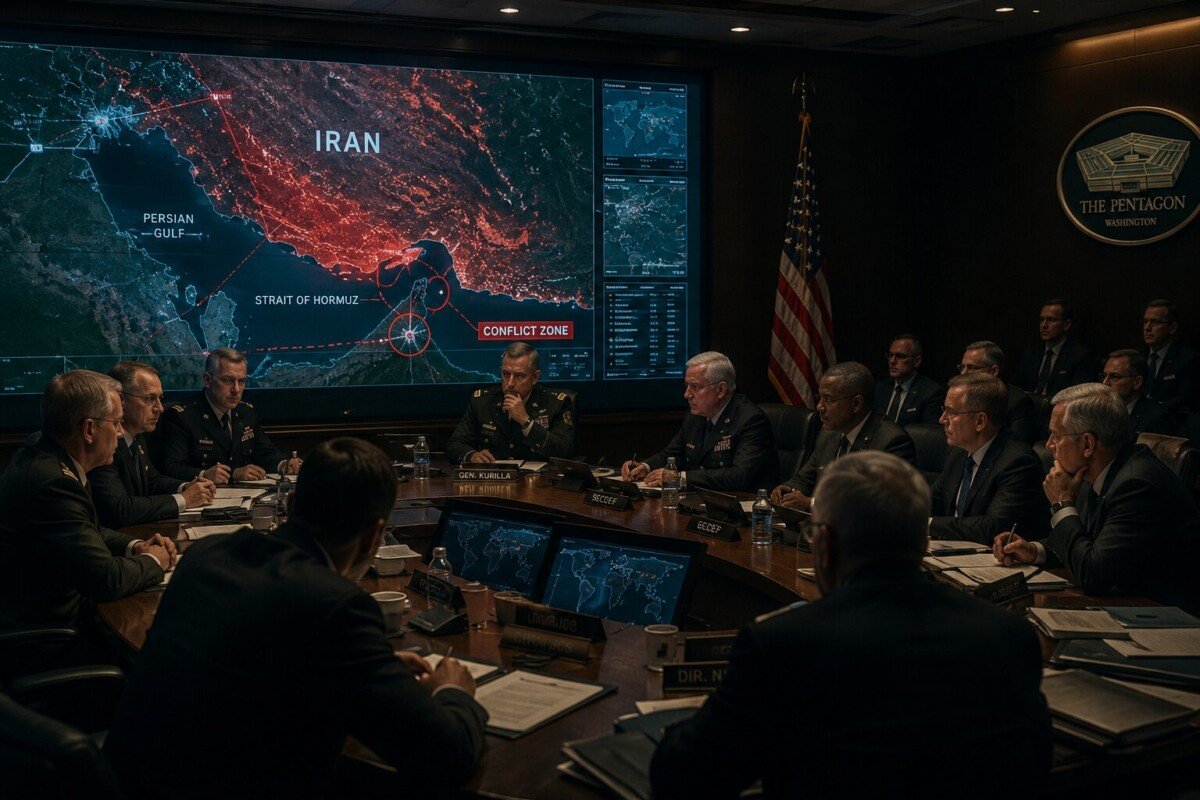
The path to war between the United States and Iran is no longer a hypothetical. It is now a classified baseline scenario inside the Pentagon, the State Department, and the intelligence community. According to an explosive New York Times investigation published today, senior American military and civilian leaders have privately concluded that the diplomatic off-ramps have vanished and that the two nations are on a collision course that neither side seems able—or willing—to stop. The question is no longer if a spark will ignite a full-scale conflict, but when, and whether anyone has a strategy to keep it from spiraling into a regional firestorm that would dwarf Iraq and Afghanistan combined.
The New York Times report, based on interviews with more than a dozen current and former officials across three administrations, paints a chilling portrait of strategic drift. What was once a decades-long game of calibrated shadow war—proxies, cyberattacks, and deniable strikes—has been replaced by an operational reality in which the U.S. military is actively maintaining and updating contingency plans for a sustained air-and-naval campaign against Iran. Worse, the report reveals that war is being treated less as a disaster to be averted and more as an inevitability to be managed.
“Inside the building, nobody talks about preventing war anymore,” one senior defense official told the Times, referring to the Pentagon. “They talk about how to fight it, how to win it quickly, and what comes after. That’s a fundamental shift, and it’s terrifying.”
How we got here: the collapse of every diplomatic track
The Iran nuclear deal, the Joint Comprehensive Plan of Action (JCPOA), died a slow death between 2018 and 2023. Revived talks collapsed repeatedly, and by mid-2026 Iran is assessed to have enriched enough uranium at 60% purity to produce multiple nuclear devices within a matter of weeks should it choose to cross the 90% weapons-grade threshold. The International Atomic Energy Agency (IAEA) reported in June that Iran had installed advanced centrifuges at its underground Fordow facility and had restricted inspector access to enrichment sites in what the agency called an “unprecedented” breach of transparency. Tehran insists its program is peaceful, but the breakout timeline—the time required to produce enough fissile material for one bomb—has shrunk to under ten days. For Pentagon planners, that window has collapsed so far that a preemptive doctrine is openly discussed.
Simultaneously, Iran’s network of regional militias—from Hezbollah in Lebanon to the Popular Mobilization Forces in Iraq, the Houthis in Yemen, and an array of Shia paramilitaries in Syria—has been given advanced drone and missile systems capable of striking American bases, Israeli cities, and Saudi oil infrastructure with pinpoint accuracy. The U.S. Central Command (CENTCOM) confirms that since January 2025, Iran-backed forces have launched more than 140 attacks on U.S. positions in eastern Syria and Iraq, a threefold increase over the prior year. Each attack brings a counterstrike; each counterstrike fuels the escalatory cycle.
The classified war plan: “Campaign Persia” and its trigger points
Multiple sources cited in the Times report reference an updated integrated campaign plan—internally nicknamed “Campaign Persia”—that outlines a phased air and maritime operation designed to degrade Iran’s nuclear program, eliminate its ballistic missile launch capabilities, destroy naval and coastal defense assets, and cripple command-and-control nodes within 72 hours. The plan envisions the deployment of B-2 and B-21 stealth bombers from bases in the continental United States and Diego Garcia, supported by carrier strike groups already rotating through the Arabian Sea and eastern Mediterranean. Five Virginia-class attack submarines with Tomahawk cruise missile loads are also reported to be part of the opening salvo.
The triggers for “Campaign Persia” are not solely tied to an overt nuclear breakout. According to the Times, the Joint Chiefs of Staff have recommended the President authorize preemptive strikes under three additional scenarios: confirmation that Iran has transferred weapons-grade material to a non-state proxy, a mass-casualty attack on a U.S. diplomatic facility or warship traced directly to Tehran, or an Iranian attempt to close the Strait of Hormuz, through which 20% of the world’s oil supply flows.
This last trigger—a Hormuz closure—is the one that most worries energy markets and the global economy. A senior Treasury official told the Times in an anonymized briefing that contingency models predict Brent crude could spike above $200 a barrel within 48 hours of any sustained disruption, triggering a global recession sharper than 2008. For a comprehensive look at how such a conflict could roil markets, analysts point to ongoing coverage of the U.S. Iran military escalation timeline and the cascading effects on fuel and shipping.
Diplomacy in a coma: backchannels that fizzled
Oman, Qatar, Switzerland, and Iraq have all served as intermediaries in the past, but officials quoted by the Times describe a diplomatic environment that is essentially nonfunctional. The Biden-like diplomatic scaffolding that existed in 2024 was dismantled after a series of cross-border attacks that killed American contractors and Iranian Revolutionary Guard Corps (IRGC) advisers. The White House has maintained a maximalist position: full suspension of enrichment above 3.67%, removal of all advanced centrifuges, and unrestricted IAEA access—conditions Iran’s Supreme Leader has publicly called “a demand for surrender.” Tehran, for its part, insists on the complete lifting of all sanctions imposed since 2018 before it will even discuss halting enrichment, a non-starter in Washington.
The election-year calendar is not helping. With midterm elections approaching in November 2026, the administration is under tremendous pressure to appear tough on Iran. Any perception of “appeasement” is a political third rail, making the kind of risky, open-ended negotiations that might yield a breakthrough all but impossible. The Times describes a White House that has stopped actively pursuing a deal and instead focuses on messaging that it will not “allow” Iran to acquire a nuclear weapon—a red line that, if tested, points directly at military action.
The regional tinderbox: Israel and the Gulf states
No discussion of the U.S.-Iran dynamic is complete without understanding the role of Israel. Israeli intelligence agencies assess the same intelligence as their American counterparts and have far less strategic patience. Prime Minister Naftali Bennett—returned to office in a coalition government in early 2026—has repeatedly stated that Israel will not allow Iran to cross the nuclear threshold and will act alone if necessary. Israeli F-35s have already conducted long-range aerial refueling exercises that replicate the flight path to Natanz and Fordow. A unilateral Israeli strike would almost certainly draw the U.S. into a wider conflict, especially if Iran retaliates with its ballistic missile arsenal against Gulf state oil facilities hosting American troops.
Saudi Arabia and the United Arab Emirates have invested billions in air defense systems, including THAAD and Patriot batteries, but their vulnerability to swarm drone attacks—demonstrated dramatically in the 2019 Abqaiq-Khurais strike and repeated with Houthi attacks since—remains acute. Diplomatically, the Gulf monarchies are caught in an impossible position: they have normalized ties with Israel through the Abraham Accords but rely on Iran for de-escalation guarantees in Yemen and cannot afford a war that would turn their oil fields into infernos. The potential for a global oil supply shock from a Gulf conflict is one of the most under-discussed economic threats of 2026.
The internal dissent: are we sleepwalking into war?
The Times report makes clear that the march toward conflict is not unanimous. Senior State Department officials, including a deputy secretary whose name was withheld because of the sensitivity of internal deliberations, have lodged formal dissent cables warning that the U.S. has no achievable political endgame in Iran. “We can destroy their nuclear infrastructure, degrade their navy, and kill Quds Force commanders,” reads one excerpt quoted in the investigation. “But we cannot occupy 1.6 million square kilometers of mountainous terrain with 88 million people without a decades-long occupation. What is the exit strategy?” The military itself is deeply divided: CENTCOM officers want clear rules of engagement and a defined mission, while some Joint Staff strategists fear a replay of the 2003 Iraq invasion—a swift conventional victory followed by a catastrophic, open-ended insurgency.
Nevertheless, the institutional momentum is real. Ships are being positioned. Bombers are being forward-deployed. Cyber Command has pre-positioned implants inside Iranian air-defense networks. The system, several officials told the Times, is “pre-armed.” At that stage, a single miscommunication—a drone that wanders into the wrong airspace, a missile that kills an American—could trigger a cascade that Washington and Tehran cannot stop.
What war would actually look like
Military simulations run by the RAND Corporation and the Center for Strategic and International Studies, cited in the Times piece, suggest that even a “limited” campaign would last a minimum of four to six weeks and involve strikes on 1,500 to 2,000 aimpoints across Iran. Civilian casualties would be substantial, especially in urban areas adjacent to nuclear and missile sites. Iranian retaliatory options include massive missile barrages on U.S. bases in Bahrain, Qatar, and the UAE, cyberattacks on American financial infrastructure, and unleashing Hezbollah’s estimated 150,000 rockets toward Israel. The estimated cost to the global economy would reach $1 trillion in the first quarter alone.
For Americans at home, a war with Iran would mean immediate spikes in gasoline prices, likely reintroduction of a draft debate, and a sharp stock market decline that would hit retirement accounts. The human cost for the Middle East is nearly incalculable. “There is no scenario in which this is quick, clean, or contained,” an intelligence community veteran told the Times. “Anyone who tells you otherwise is lying to themselves.”
Is there a way out?
Some former officials quoted in the investigation hold out hope that the sheer scale of the catastrophe could force a breakthrough. They argue that a combination of a credible military threat and a genuine diplomatic offer—perhaps a “more-for-more” deal that allows Iran limited enrichment under strict international supervision in exchange for sanctions relief—might still be viable. But the political window for such a deal, they concede, is down to weeks, not months.
Others see the only off-ramp as a direct, face-to-face channel between the Supreme Leader and the U.S. President, similar to the secret correspondence that helped defuse the Cuban Missile Crisis. No such channel exists. The Times reports that the White House has rejected multiple proposals from European allies to host high-level talks, fearing that a failed summit would accelerate the march to war rather than halt it.
For now, the engines of conflict drown out the whispers of peace. A generation of policymakers who came of age in the post-9/11 era is again staring into a Middle Eastern abyss, having seemingly learned little about the limits of military power to solve political problems. The average American, distracted by domestic concerns and weary of foreign entanglements, may not realize how close the nation is to another war until the first bombs fall.
The New York Times investigation closes with a quote from a retired four-star general that serves as both warning and epitaph: “We are not choosing war. We are drifting into it. And that is the most dangerous way to start one.”
The world will watch the Strait of Hormuz, the enrichment halls of Natanz, and the hotline between Washington and Tel Aviv with bated breath. In 2026, the margin for error is measured in minutes, not months. And right now, the clock is ticking.